The Millennial Kingdom Teaching: The Heart of the Matter
The Millennial Kingdom Teaching:
The Heart of the Matter is the Acid Test*
*A strong acid used to distinguish gold from base metals.
Background Study:
https://www.thethirdheaventraveler.com/2026/05/etymology-of-tripartite.html
In my continued study of Ezekiel’s magnificent Temple vision (chapters 40–48), I have come to see a clear two-fold revelation. I do not present this as superior or infallible, but as a humble attempt to hold together what Scripture reveals in both its spiritual depth and its literal application in our day.
Matthew Poole and John Gill, two of the most respected KJV-era commentators, beautifully unfold the spiritual and figurative fulfillment of this vision. They rightly point us to the glorious Gospel Church and the ultimate Millennial Kingdom where Christ Himself is the Temple — “Jehovah Shammah” — and the river of life flows freely, bringing healing to the nations. With this I am in full agreement.
At the same time, the Lord has granted our generation increased knowledge (Daniel 12:4). The Temple Institute in Jerusalem is openly using the precise measurements, gates, courts, and architectural details given in Ezekiel 40–48 as their literal blueprint for the coming Third Temple. Their own writings describe Ezekiel’s vision as “an unparalleled architectural blueprint” for the Temple they are actively preparing.
When we talk about the Temple Institute’s conceptual plans, we mean they’re working with the vision described in Ezekiel, but translating it into modern architectural terms. Ezekiel’s chapters 40 through 48 lay out measurements and elements of the temple, but they’re often symbolic or lacking practical details—things like exact heights, materials, or structural engineering needs. The Temple Institute takes these biblical descriptions as a starting point, then fills in the gaps with modern architectural standards, so they can visualize what a functional, buildable structure would look like.
So “conceptual plans” include creating scale models, drafting floor plans, and proposing dimensions that align with Ezekiel’s vision but also meet today’s engineering principles. They’re not construction blueprints ready for permitting; they’re detailed visualizations that help people understand how the ancient vision might translate into a real-world temple. They consider things like the outer court’s width and length, how many entry gates there would be, and how these would fit into the topography of Jerusalem today.
Thus, the vision reveals two realities: the detailed plans are being followed literally today for what will become the Tribulation Temple (soon to be desecrated by the Antichrist), while its ultimate and glorious fulfillment remains spiritual and millennial in the Kingdom of our Lord Jesus Christ.
I humbly offer this two-fold understanding, not to contradict the faithful giants of the past, but to walk in the additional light God has graciously given our generation.
Preface:
More smoking gun evidence that the spiritual version of Ezekiel's Temple will be fulfilled in the Millennial Kingdom existing as NOT a separate Temple but Rather Jesus Christ himself standing in the center of the New Jerusalem: Ezekiel 43:7 and Hebrews 10:1-23 KJB: Regarding the physical fulfillment of Ezekiel's temple whereby the AC builds the literal temple to appeal to and fool the JEWS, look to Daniel 9:27, Daniel Chapter 11, specifically verse 45 and the context of chapter 11, and Daniel 12:11 KJB.
The Following is a detailed summary and synopsis of this BLOG
The Millennial Kingdom Teaching: The Heart of the Matter
This Blog presents a strong, scripture-centered critique of popular dispensational views on a literal earthly millennial temple.
BLOG argues persuasively that Ezekiel 40–48 describes a physical temple tied to the Tribulation period, involving the Antichrist (referencing 2 Thessalonians 2:4 and Daniel 9:27), rather than a millennial kingdom structure or the eternal New Jerusalem. Key strengths include BLOG emphasis on the literal details of animal sacrifices and sin offerings in Ezekiel (e.g., Ezekiel 43:18–27, 45:15–25), which BLOG contrasts with the sacrifice-free eternal state, and BLOG Points that forcing Ezekiel into a millennial framework requires inconsistent allegorization despite the text's precise measurements (Ezekiel 40:5).
BLOG also ties this to spiritual fulfillment in Christ as the true temple (Hebrews 10:1–23) while warning of end-time deception for Israel. Overall, it's a clear, KJV-based exposition that challenges readers to re-examine assumptions about prophecy timelines. Well done—it's thorough and rooted in a consistent literal hermeneutic where it counts.
Key features include:
- Physical structure and dimensions: A walled square enclosure (500 cubits per side, Ezekiel 42:15–20), outer and inner courts, gates with palm decorations and steps, a temple building with porch, holy place, and most holy place (Ezekiel 41), side chambers, and a massive altar with horns and steps eastward (Ezekiel 43:13–17).
- Sacrificial system: Explicit animal sacrifices, including daily burnt offerings, sin offerings (young bulls, goats), guilt offerings, and festival offerings (Passover, Tabernacles; Ezekiel 45:21–25). The altar is consecrated with seven days of sin offerings (Ezekiel 43:18–27), and the prince provides sin offerings for himself and the people (Ezekiel 45:22).
- Priesthood and prince: Only Zadokite priests minister (Ezekiel 44:15–16), with strict rules on garments, marriage, and purity. A "prince" has a special role, eating bread before the Lord, providing offerings (including for his own sin), and receiving land inheritance (Ezekiel 45:7–8, 46:16–18).
- River and land: Water flows from under the threshold, deepening into a life-giving river that heals the Dead Sea (Ezekiel 47:1–12). The land is divided equally among the 12 tribes, with a sacred portion for priests, Levites, city, and prince (Ezekiel 45–48).
- Ongoing rituals and mortality implied: Regulations for unintentional sins, purification after contact with death (Ezekiel 44:25–27), and the prince's personal sin offerings all point to a setting where sin and death persist.
- No physical temple: "And I saw no temple therein: for the Lord God Almighty and the Lamb are the temple of it" (Revelation 21:22).
- Direct divine presence: God's throne is central, with the river of life flowing from it (Revelation 22:1); no night, curse, or impurity (Revelation 21:25, 22:3); nothing shameful enters (Revelation 21:27).
- Dimensions and materials: A perfect cube city (12,000 furlongs length/width/height), walls of jasper, streets of pure gold, gates of pearls, foundations of precious stones (Revelation 21:12–21).
- Life and healing: Tree of life on either side of the river, bearing 12 fruits monthly, leaves for healing of nations (Revelation 22:2)—but in a context of perfected eternity, not remedial sin offerings.
- No sacrifices or mortality: Complete removal of curse and death; God wipes away all tears (Revelation 21:4).
- Ezekiel's temple requires ongoing animal sin offerings in a world where sin still occurs—impossible in the eternal state where the Lamb's once-for-all sacrifice has fully eradicated sin (Hebrews 10:10–14).
- A physical building with restricted access (holy/separate from common) contradicts the open, direct access to God in New Jerusalem.
- Mortality markers (sin offerings for the prince, purification rites) cannot coexist with "no more death" (Revelation 21:4).
- The settings differ: Ezekiel's vision assumes Israel's tribal structure on earth with foreigners integrated (Ezekiel 47:22–23), while New Jerusalem descends after the final judgment, encompassing all redeemed without national distinctions in that form.
- The Temple Institute in Jerusalem has recreated vessels, garments, and even trained priests, using Ezekiel's descriptions for elements like chambers, altar design, and overall layout where Torah details are lacking for a future temple. Their illustrated tours and plans reference Ezekiel extensively for inner courts and sanctuary features.
- Chabad Lubavitch teaches that Ezekiel's vision details the Third Temple, to be built in the Messianic era. Their writings discuss why it wasn't built after the Babylonian exile (partial repentance) and anticipate its fulfillment soon, with the Rebbe emphasizing temple rebuilding as central to redemption.
CHART Comparison of Ezekiel Temple Scriptures to Tribulation
Ezekiel Reference (KJV) | Key Element in Ezekiel's Temple Vision | Parallel to Tribulation Scriptures |
|---|---|---|
Ezekiel 40:1–42:20 (Extensive measuring of the temple, gates, chambers, courts, and walls) | Ezekiel receives a reed to measure every detail of the temple structure, including inner/outer courts and separating walls (e.g., 42:20: "to make a separation between the sanctuary and the profane place"). | Revelation 11:1–2: John receives a reed to "measure the temple of God, and the altar, and them that worship therein," but to "leave out the court... for it is given unto the Gentiles: and the holy city shall they tread under foot forty and two months." Direct parallel in measuring the temple amid distinction/separation during Gentile trampling (42 months = latter half of Tribulation). |
Ezekiel 43:18–27; 44:15–31; 45:15–25 (Altar consecration, sin offerings, daily sacrifices, Passover/Feast offerings resumed) | Detailed ordinances for blood sacrifices, sin offerings, and ongoing ritual worship to consecrate and maintain the altar/temple. | Daniel 9:27: The "prince" confirms a covenant (implying restored sacrifices), then "in the midst of the week... cause the sacrifice and the oblation to cease, and for the overspreading of abominations he shall make it desolate." Also Daniel 11:31; 12:11 and Matthew 24:15 (abomination of desolation standing in the holy place). Parallel: Functional temple sacrifices that are halted mid-Tribulation by the Antichrist. |
Ezekiel 45:21–25; 46:1–15 (Ongoing feasts and offerings in the temple system) | Resumption of Passover, feasts, and regular offerings. | Daniel 9:27 and related passages (as above): Parallel in a restored Jewish sacrificial system in a future temple, temporarily active before Antichrist's interruption and abomination (2 Thessalonians 2:4: he "sitteth in the temple of God, shewing himself that he is God"). |
Ezekiel 44:1–3; 46:2–12 (East gate shut after glory enters; only the "prince" uses it for worship/offerings) | The prince has special access and provides offerings. | Parallel to 2 Thessalonians 2:3–4 (man of sin exalting himself in the temple) and Antichrist's control over temple access during Tribulation deception. The "prince" (nasi) fits as a future ruler figure in the transitional Tribulation period. |
Ezekiel 45:22; 46:4–12 (The prince offers sin offerings for himself and the people) | The prince personally provides and participates in sin offerings (implying need for atonement). | Parallel to Tribulation context: Fits unbelieving or transitional Israel under Antichrist's rise (links to Daniel 7's "little horn" exalting himself and changing times/laws, Dan 7:25), before full restoration. |
Ezekiel 43:1–5 (Glory of the Lord returns and fills the temple from the east) | Divine presence returns after prior departure (cf. Ezek 8–11 abominations caused glory to leave). | Parallel pattern: Temple defilement then temporary restoration, matching Tribulation sequence—temple function before desecration (abomination of desolation), followed by ultimate cleansing at Christ's return (indirect tie to Daniel 7:13–14, Son of Man receiving dominion after beasts/horn defeated). |
Zechariah 13:9
“And I will bring the third part through the fire, and will refine them as silver is refined, and will try them as gold is tried: they shall call on my name, and I will hear them: I will say, It is my people: and they shall say, The LORD is my God.”
King James Version (KJV)
Just as the JEWISH REMNANT will be tried and refined, we see a major separation within the group of Christians. We know them by their fruit. The separation is the Church of Philadelphia vs the Church of Laodicea.
We see this and we can tell whom each belongs by
Matthew 7:16
“Ye shall know them by their fruits. Do men gather grapes of thorns, or figs of thistles?”
King James Version (KJV)
Background: This study has proven to be one of the most challenging because of the OVERWHELMING preponderance of compiled evidence stacked up against what I have intuitively, spiritually and from study known for years. Before the Lord revealed the truth of this subject, He had to peel away layers of wrong doctrine* through HIS WORD - The King James Bible through reading it carefully precept upon precept. This entire study really comes down to “Who” NOT “What” is ISRAEL.
Therefore, it is most essential the reader have a thorough background understanding of this subject. Please see related studies if you don’t understand fully the MYSTERY as given to Paul which was ultimately The Church is grafted into the seed of Abraham and are ONE in ISRAEL and this is all in the DISPENSATION and AGE OF GRACE, The Church are new Creatures in Christ.
This is not new as an enemy to the church. This was also at the heart of the Paul Barnabas disagreement; study the Jerusalem Council and why Paul confronts Peter in Antioch i.e., JUDAIZERS VS Mystery given to Paul = Gentiles are grafted into the branch of Abraham.
Hyper-Dispensationalists struggle mightily with the same. Even Dr Andy Woods who rebukes the Judaizers can't grasp the mystery and parrots the same as they, "Mystery is the Gospel of Grace." (Which it is in part but the same as saying an ICEBERG is only what is seen above the water surface. The entire understanding of the MYSTERY is ONE IN ISRAEL, this is discussed in Romans 2:27-29, Romans 11:17-24, 16:25, Colossians 1:26,27, 2:1-3, Ephesians 2:2-6.
All One in Israel because we're grafted into the branch of Abraham. I have extensive studies on this as you're aware and I sincerely pray the reader will be able to study this:
The Armies of Heaven - The Wedding Supper of the Lamb - One in Israel (thethirdheaventraveler.com)
Paul gets really real in Romans 9 about WHO not WHAT is ISRAEL (thethirdheaventraveler.com)
DOCTRINE MATTERS:
Doctrine is: Learning The Teaching of the Word of God (thethirdheaventraveler.com)
Don’t get me wrong, in addition to overcoming the ocean of misinformation in bible commentary ranging from AMILLENNIAL* INSANITY
Amillennialists believe that the millennium is a heavenly rule inaugurated at the death and resurrection of Christ and concluding at his return1. The thousand-year span given in Revelation 20:1-10 is not a literal thousand years, but rather symbolizes a long period representing the entire church age from the cross to the second coming1. Amillennialism teaches that the Book of Revelation is currently being experienced in the present church age2. Amillennialists believe that the End Times are already being fulfilled now, rather than looking for the Rapture to start the beginning of the End Times as pre-tribulationists do2.
Learn more:
To the ZIONIST and Judaizer - Messianic Jew false teaching that ISRAEL is the state of Israel and ALL of the Jewish People*
My example: The ultra Zionist Wolf clothed as an Evangelical Judeo-Christian (using his website information that I have blogged in depth) none other than Amir Tsarfati himself. His Millennial Kingdom teaching is my best case study.
Tsarfsti Believes 4th temple and the remnant is all Jews,
The sheep goat judgment is how we treat national Israel> insinuated . Jews today.
If you’d like, check out Amir Tsarfati’s decent Premillennial teaching on the level of children’s Sunday school class. He gives the overview quite simply. But when you study what he states, especially his perverted Bible usage, we find misquotes, and mangles horribly key scriptures, and ends up creating his own scenario regarding the Millennial Temple being the 4th Temple and how the Millennium will be the Old Testament sacrifices, (insinuating the full blown law in place.) He then teaches a complete misunderstanding of the Sheep and Goat Judgment. He is telling us ISRAEL - JEWS in a heavy hand of insinuation that we all (any non Jew) will be judged by the way we treat today’s National Israel and Jewish People. He doesn’t bother telling us that this Judgment will be those who see the JEWISH people suffering mightily from the hand of the Antichrist and do not help them. And where does Amir get this JEWISH TEMPLE information? Even Worse: Tsarfati has no clue of what the FEAST OF TABERNACLES represents, and this is the key they all miss. Including why Ezekiel's Temple Prophecy is quoted by Paul.
I kept going over Tsarfati’s references and found that he as well as all the other false teachers get their foundation from Ezekiel’s Prophetic Temple Ezekiel 40-48.
Note: See extensive information refuting the Judaizers notion of Ezekiel’s Temple. The TRAP used by the Zionists - JudaIzers to ensnare the unlearned who do not study their King James bible.
Since Tsarfati has risen as a premier (prince as his name says in Arabic) spokesperson of the Zionists to lead the Evangelical non bible reading sheeple to a pit, I urge those who don’t know his continual false teaching to read these studies:
Yes another example I use is another Jew either by heritage, maternal ethnicity, religion here in this link which hangs their entire LITERAL interpretation once again on Ezekiel 40-48. See link study and commentary in NOTES below.
And of course ALL of the Evangelical Zionist Messianic PreMillennial scholars all go to Ezekiel 40-48 as well.
A few shocking examples
Note: Two shocking discoveries dawned heavily upon me while doing this study.
Why do the hyper-dispensationalists want the church to remain in heaven and never have any interaction on earth in the Millennial Kingdom?
Their inability to rightly divide as we are commanded - 2 Timothy 2:15, (the irony is unfathomable considering Dispensationalists claim they rightly divide) and not fully comprehending the MYSTERY given to Paul - (The Church and Israel are one in the dispensation of GRACE see my studies) an even more shocking irony considering they are PAUL only - Romans - Philemon believers. This has left the Hyper-Dispensationalists to be taken as spoils by the enemy. They’ve allowed themselves to not only fall prey to the JUDADIZERS who have convinced them that ISRAEL is for the JEWS only and the Church never was grafted into the branch of Abraham, but they are taken as spoil as Paul warned them in Colossians 2:9.
Note this commentary by this Messianic Jew Arnold Fruchtenbaum
www.ariel.org (in English); www.ariel-israel.org.il (in Hebrew). Arnold Fruchtenbaum is the founder and director of Ariel Ministries, a U.S. based ministry that has been providing Bible teaching from a Messianic Jewish perspective for over 40 years.
Third Objection: To believe in the reinstitution of the blood sacrifices is heresy.
Answer: Since when is taking the Bible literally a heresy? The burden of proof is always on the one who claims that a certain part of the Bible does not mean what it says. Whitcomb adds: “Just because animal sacrifices and priests have no place in Christianity does not mean that they will have no place in Israel after the rapture of the Church; for there is a clear distinction made throughout the Scriptures between Israel and the Church.”[10]
[10] John C. Whitcomb. “The Millennial Temple of Ezekiel 40–48”. The Diligent Workman Journal, May 1994, pg. 22.
This is all promoted by the MEGA EVANGELICAL (So called) Jewish Messianic? Joel Rosenberg See my many studies exposing this very wicked man:
Israel News » Kehila News Israel
Note: I was once again astounded by the outrageous hubris and arrogance of Joel Rosenberg. When posting this work he has an article telling Evangelical Christians how to pray - all aligned with out of context scriptures aimed at the ZIONIST regime. Please listen: We need to pray as Paul prayed in Romans 10:1: ISRAEL - The remnant as clearly defined in Romans Chapter 9 - be saved. Praying for the PEACE of Jerusalem is the Messianic Kingdom prayer of David, but Zionists always use this out of context to pray that National Israel be saved which is not what Paul is talking about.
The ongoing fight against the Jewishness of Jesus | All Israel News
This is the insanity that reigns: See Michael Brown of AskDr Brown
Why Messianic Jews will not call themselves Christians (thethirdheaventraveler.com)
The Judaizers have not gone away. They refuse to see that there is neither JEW nor GENTILE in Christ. They do not understand ISRAEL and WHO not WHAT Israel is.
On the other side of this evil coin is the HYPER DISPENSATIONALISTS
And the HYPER-DISPENSATIONALISTS do not understand what the word ISRAEL means in the Dispensation of GRACE. Sadly they are taught to disregard major portions of the Bible, to remain in
Romans - Philemon and the BOOK of Revelation belongs to the JEWS who they term as ISRAEL. The many Hyper-Dispensationalists I have spent time trying to teach the truth - RIGHTLY DIVIDED - NOT OVER DIVIDED, it is abundantly clear they can not distinguish the difference. These Hyper-Dispensationalists get false leaven from a teacher that correctly reads Ezekiel 40-48 and the LAW of Leviticus regarding the TEMPLE sacrifices and no wonder they come to their misguided thinking that the Church is NOT the Bride, that the Church will NOT reign with Jesus Christ on THE EARTH; that the Church will spend the Millennial reign in heaven, and that the Church and ISRAEL are two absolute distinct entities even through there is more than more than enough evidence to the contrary. See my exhaustive studies.
The Armies of Heaven - The Wedding Supper of the Lamb - One in Israel (thethirdheaventraveler.com)
Don't touch God's ELECT - Understanding God's ELECT (thethirdheaventraveler.com)
I had to overcome that mountain of my upbringing of Evangelical Zionism and that ISRAEL and the Church are two polar opposites and on completely different programs from each other. Note: When I use the word Israel I am NOT referring to National Israel as all Messianic and Zionists try to tell us. Also I am certainly not talking about the ethnicity of Jewish people (which is a huge misnomer anyway because the word Jew has absolutely nothing to do with ethnicity, but rather RELIGION - Judaism.*
Note: Read the book, “The Invention of the Jewish People” by Shlomo Sand, a renowned Israeli historian and anthropologist. Also read my study: The True JEW
The True Jew (thethirdheaventraveler.com)
Why is all of this a very big deal?
Revelation 3:7-12 KJB
The Church of Philadelphia VS The Church of Laodicea (thethirdheaventraveler.com)
LET NO MAN TAKE THY CROWN
Colossians 2:8
“Beware lest any man spoil you through philosophy and vain deceit, after the tradition of men, after the rudiments of the world, and not after Christ.”
King James Version (KJV)
The Incorruptible Crown is the OVERCOMERS CROWN
1 Corinthians 9:25
“And every man that striveth for the mastery is temperate in all things. Now they do it to obtain a corruptible crown; but we an incorruptible.”
King James Version (KJV)
2 Timothy 2:5
“And if a man also strive for masteries, yet is he not crowned, except he strive lawfully.”
King James Version (KJV)
Romans 8:37
“Nay, in all these things we are more than conquerors through him that loved us.”
King James Version (KJV)
Revelation 3:5
“He that overcometh, the same shall be clothed in white raiment; and I will not blot out his name out of the book of life, but I will confess his name before my Father, and before his angels.”
King James Version (KJV)
Revelation 3:11
“Behold, I come quickly: hold that fast which thou hast, that no man take thy crown.”
King James Version (KJV)
Revelation 3:21
“To him that overcometh will I grant to sit with me in my throne, even as I also overcame, and am set down with my Father in his throne.”
King James Version (KJV)
Revelation 12:5 - Revelation 3:21 Connection
THE CROWN OF OVERCOMERS
Note: The Church is blessed to be an overcomer by GRACE through the Faith of Jesus Christ alone and working out this SALVATION with fear and trembling in our works of Sanctification but NOT to obtain salvation. The Tribulation Saints who enter the Tribulation must overcome by works to Salvation and by FAITH. No doubt most will be martyred for their stand. The Hyper-Dispensationalists try to remove the Church out of the Church of Philadelphia in the book of Revelation.
We Saints will literally rule with Christ (thethirdheaventraveler.com)
The Church of Philadelphia VS The Church of Laodicea (thethirdheaventraveler.com)
The Study:
Revelation 21:1
“And I saw a new heaven and a new earth: for the first heaven and the first earth were passed away; and there was no more sea.”
King James Version (KJV)
Revelation 21:2
“And I John saw the holy city, new Jerusalem, coming down from God out of heaven, prepared as a bride adorned for her husband.”
King James Version (KJV)
THE NEW JERUSALEM IS THE KINGDOM OF GOD and IT WILL COME DOWN TO EARTH AFTER THE SECOND COMING OF JESUS CHRIST WITH HIS SAINTS AND NOT AT THE END OF THE MILLENNIUM.
This is where Jesus Christ will rule the nations. There will be NO temple in this incredible structure measuring 1,500 cubic miles of which I believe there is strong evidence this will be in the form of a Pyramid. See my study:
The Book of Revelation ends with the Millennial Kingdom and the ETERNAL STATE although not stated is implied by logic knowing that when 1,000 years ends, we would obviously enter into ETERNITY.
One of the biggest hurdles I’ve encountered in all my years of studying the Bible is grasping and mapping out one of the major literary devices known as “Literary Interlude” that may or may not function like a parenthetical pause, but most often functions in a complete change of scene,or subject. If you’re unaware of this please do an independent study on Interludes in the Bible.
An interlude in the Bible is a pause or a break in the narration or the music12. It may indicate a change of scene, a shift of focus, or a moment of reflection.
But even before understanding the Literary Interlude, I find a great deal of us need stronger skills in solid bible hermeneutics based on Context, which is often - I find - the biggest culprit in understanding scripture, Exegesis - in part understanding of grammar, syntax, vocabulary, etc, and Harmonizing Scripture with scripture. If you’re not familiar with these terms and you may struggle understanding scripture, please study my study on how to study the KING JAMES BIBLE.*
*Note: I repeat this all the time. IF YOU ARE NOT USING A KING JAMES BIBLE YOU ARE ON THE WRONG PATH.
Understand the Bible - From a Workman Approved unto God by His Grace (thethirdheaventraveler.com)
Interlude is used frequently in scripture especially in the Old Testament Prophets. When we read and study the book of Revelation, identifying and understanding the Interlude is essential. Some of the prime examples of interlude are found in Paul’s shift in Romans chapters 9 through 11 which is a major shift of focus, but in Revelation scriptures like Revelation Chapter 12, and Revelation Chapter 21 (The New Jerusalem), the focus of this study, the shift in focus goes into a complete shift of scene and circumstances. which brings to the subject of this study.
To make this as simple as possible, working through an interlude requires STUDY and study is hard work as you’ll find in my study on Understanding the Bible. It is the 3rd step in Bible Hermeneutics - Harmonizing Scripture - that must be used thoroughly.
Just as Revelation 12 stops from the chronological linear record of events from the 7th Trumpet Judgment - Revelation 11:19 The Temple of God (The New Jerusalem while still in Heaven) is in view - to go back in the chronology and identify The Church Raptured (HARPAZO G726) as well as the Tribulation Saints and the Jewish Remnants situation - Revelation 21 sets up the Beginning of the Millenium. If the reader has done even a cursory reading of scripture one has discovered it not unusual to be reading an Old Testament prophet for example talking about present, near future and extreme future events in the same scripture. One also finds that one chapter goes back into time and another goes far into the future. Just as one of hundreds of examples please go to Isaiah Chapter 11. We see here prophecy showing Jesus Christ, the Church (who is grafted into the branch) in verse 1 that sets up the Millennial Kingdom then Isaiah jumps into the Battle of Armageddon and the 2nd Advent of Revelation 19, verses 4,5, on to verse 6 we see we’re looking at the Millennial kingdom and in verse 11 we’re looking at the recovery of the Jewish Remnant that takes place during the middle of the Tribulation and outlined in Revelation 12:6,13.
Revelation 12 Sign
It is here I urge the reader to carefully read and compare verse1 of Revelation 21 to see it harmonizes perfectly with all scripture throughout the Bible that discusses the Burning of the Earth as Part of God’s judgment. Perfect case and point:
2 Peter 3:10
“But the day of the Lord will come as a thief in the night; in the which the heavens shall pass away with a great noise, and the elements shall melt with fervent heat, the earth also and the works that are therein shall be burned up.”
King James Version (KJV)
Most Bible Scholars believe 2 Peter is referring to Revelation 6:1 The Beginning of the Tribulation, and then in the subordinate clause moves 1,000 years after the end of the Millennial Reign.
This is a great error because of the prepositional phrase “in the which” means the beginning of the Tribulation begins the process of burning away the old world and its systems in judgment by fire.
They get this logic believing Revelation 20:1 which I agree that it certainly is. Here are a few other major scriptures that are speaking of the same event.
Harmonizing scripture with scripture Revelation 3:3, Psalm Revelation 16:15, Fire consuming the earth is Tribulation See Revelation Chapters 8 and 9, 16:8, See 2 Peter 3:10-12, Joel 2:30, Acts 2:19 KJB, Psalm 102:26, Micah 1:4,* Isaiah 24:19, 34:4, 51:6, Malachi Chapter 4 [including the 2 Witnesses proving the Tribulation] and many other scriptures.
Note: The absolute proof is reading Micah 1:4 in context: This is the 2nd Coming of Jesus Christ when he touches down on the Mount Of Olives. It reads before the fire that reigns down.
The heading in Micah 1:1 has been explained in the introduction. Micah 1:2-4 form the introduction to the prophet's address. Micah 1:2. "Hear, all ye nations: observe, O earth, and that which fills it: and let the Lord Jehovah be a witness against you, the Lord out of His holy palace. Micah 1:3. For, behold, Jehovah cometh forth from His place, and cometh down, and marcheth over the high places of the earth. Micah 1:4. And the mountains will melt under Him, and the valleys split, like wax before the fire, like water poured out upon a slope." The introductory words, "Hear, ye nations all," are taken by Micah from his earlier namesake the son of Imlah (1 Kings 22:28). As the latter, in his attack upon the false prophets, called all nations as witnesses to confirm the truth of his prophecy, so does Micah the Morashite commence his prophetic testimony with the same appeal, so as to announce his labours at the very outset as a continuation of the activity of his predecessor who had been so zealous for the Lord.
Other major points proving the New Jerusalem comes down in the beginning of the Millennial Kingdom and that Ezekiel 40-47 (Ezekiel’s Temple - Tabernacle of God) FOR THE CHURCH (ALL ONE IN ISRAEL to include the Tribulation Saints, The Jewish Remnant, and the Old Testament Saints) is a prophetic, figurative-spiritual expression - type and shadow of THE LORD IN THE MIDST OF THEE Zephaniah 3:14-20 Solemn Assembly. Tabernacles Feast Fulilled we must understand exactly what that entails
For the LOST Ezekiel 40-48 Provides the Paradigm for the 3rd TEMPLE.
YES oh Yes. Please pause, get your notebook out:
The go to scripture for the false teachers trying to prove JEWS - JUDAISM in its basis are in full operation during the Millennial Kingdom is of course Ezekiel 40-48 aka known as Ezekiel’s temple.
There is an extensive amount of study on this, and all teaching out there comes down to 3 concepts: 1. Ezekiel’s temple is purely allegorical and spiritual. 2. Ezekiel’s temple is literal and will be built by Jesus Christ in the Millennial Kingdom. 3. Ezekiel’s temple will be the plans the false messiah uses to snag the Jews.
In my weeks of researching this I am more than convinced that most of the Church believes Jesus will forfeit all scripture and return 100% back to the LAW is both heretical and frankly blasphemous to believe the Millennial Kingdom will be back to 100% Law including sacrifices. The false teachers as you’ll see in notes below, try force a square peg into a round hole by saying all the sacrifices are symbolic, trying to misquote Hebrews 9:13, and 10:18 by saying that the blood of sacrifices is never permanent and therefore it is just symbolic.
This is what the MESSIANIC JEWS, JUDAIZERS and JEWS truly believe and teach. You will see the commentary in Notes below. What’s more disturbing is that all Evangelical Zionist Christians believe the same thing. Hence the perfect plan to set the NEW APOSTOLIC REFORMATION, KINGDOM BUILDING false teachers into motion and on the other side of the EVIL COIN the Hyper-Dispensationalists who think we the BRIDE will be in Heaven and Israel on earth.
I pray your eyes can be opened to the truth to see my evidence here that proves Ezekiel’s TEMPLE was removed when the Jews rejected Jesus Christ as their MESSIAH. See my extensive studies on the Kingdom and the Matthew 13 Parables. The Kingdom Parables are imperative to understand yet the Hyper-Dispensationalists have thrown out the baby with the bath water.
What we do see is the prophetic fulfillment of Ezekiel’s Temple when Jesus Christ establishes his reign on earth after he touches down on the Mount of Olives and enters the East GATE of whatever is left of the city of Jerusalem after it has been thoroughly destroyed. We know this will be completely symbolic since the original city walls and gates are not exactly the same when Jesus entered on the foal of the donkey.
Back on point:
The key to understanding why Jesus completely fulfills ALL of Ezekiel’s Temple is there is NO TEMPLE inside the New Jerusalem, but Jesus is the all in all within the city.
Speaking of Literary Interlude again, we read in Revelation 11:1,2 is as a cataphoric reference to the NEW JERUSALEM. Evidence: There is NO Temple, Jesus is the Temple or fulfills the Temple - all Priestly role and we with him. We reign as Kings and Priests.
Hebrews Chapter 7 and Psalm 110.
Revelation 1:6 KJB.
See my study on Melchizedek.
Important note: There will be 2 Feasts that will continue that are NOT sacrificial feasts and that is TABERNACLES and COMMUNION - PASSOVER without the sacrifice as we practice in Communion - The Lord’s supper in the same manner we do today. Jesus states in Matthew 26:29:
29 But I say unto you, I will not drink henceforth of this fruit of the vine, until that day when I drink it new with you in my Father's kingdom.
See Study notes below regarding TABERNACLES connection to Water and Light. Rain. If the inhabitants do not make the PILGRIMAGE to the New Jerusalem, they will not receive rain on their crops.
Note: See in notes below how in the Millennial Kingdom animals will be eating grass, how the earth will be an agrarian society, etc.
Now for the intricate dimension of Ezekiel’s temple, there is no doubt in my mind as proven by Chabad’s commentary that Ezekiel’s temple will be the template for the AntiChrist aka the third temple. Before you turn off your mind to this, I urge and plead with you to study my notes below first.
You must understand that all the false teachers of the Laodicean Church are misleading the Jewish People who literally are looking for the AntiChrist as their Messiah. CHABAD is the King Jew Daddy working no doubt with the knowledge of the Temple Institute for JEREMIAH’s Temple.
Before I close this study, I urge the reader to go through the remaining verses of Revelation 21 and 22 to see verse after verse harmonizes perfectly with the Millennial Kingdom - examples like Revelation 22:14 and the stark difference of verse 15 showing the NEW JERUSALEM has GATES a WALL to keep some outside. If indeed Revelation 21 and 22 were the Eternal State then why would there still be those who remain out of the GATE and we know those are the ones who will no doubt turn on Jerusalem when Satan is released for a season in Revelation 20:3, 7, 8 (Ezekiel 38 War). So again, how can one believe Revelation 21 and 22 are the Eternal State when we still see evil outside the gates in Revelation 21:8 and 22:15 when the GREAT WHITE THRONE JUDGMENT has already happened in Revelation 20:11-15? Additionally, of course, we fully understand that after 1,000 years the Millennial period will end and our Lord has not revealed to us what exactly the Eternal State will look like.
Note: IF the Kingdom of Heaven remains suspended in the sky why are there gates and the sinful remaining outside the gates?
In Conclusion: I pray eyes be opened. Time is short. What we do here in this REALM has ETERNAL Consequences. Don’t be like a man I once knew who said, “All that futuristic stuff is too complicated, It really doesn’t matter. It will all work itself out in the End. I don’t have time to worry about that now. God has it all in hand.” I said under my breath. Ok, fine, Go back to sleep.” And had 1 Thessalonians 5 going through my mind:
1 But of the times and the seasons, brethren, ye have no need that I write unto you.
For yourselves know perfectly that the day of the Lord so cometh as a thief in the night.
But ye, brethren, are not in darkness, that that day should overtake you as a thief.
Therefore let us not sleep, as do others; but let us watch and be sober.
For they that sleep sleep in the night; and they that be drunken are drunken in the night.
For God hath not appointed us to wrath, but to obtain salvation by our Lord Jesus Christ,
Who died for us, that, whether we wake or sleep, we should live together with him.
Wherefore comfort yourselves together, and edify one another, even as also ye do.
Please See Notes discussing the 3 major interpretations of DOCTRINE of Jesus Christ in Ezekiel’s Temple Prophecy in relation to the NEW JERUSALEM as follows:
Ezekiel’s Temple is spiritual/allegorical representing Jesus Christ inhabiting the NEW JERUSALEM that does not have a temple.
Ezekiel’s Temple will be the 3rd Temple authorized by the AntiChrist
Ezekiel’s Temple is literal in detail which Jesus Christ will oversee the building and inhabit this temple back to the law for 1,000 years, Then after the 1,000 years, the New Jerusalem will usher in the Eternal State and Ezekiel’s temple will no longer exist.
Note: For classification purposes, I will include a note of those who think The New Jerusalem will hover over the surface of the earth but not touch down which is not scripture whatsoever. There's also a commentary from some misguided soul who believes New Jeruslam is the BRIDE and that there is no Physical New Jerusalem.
The more you study this, the more you may see how this is essential in our understanding of the MILLENNIAL KINGDOM:
NOTES:
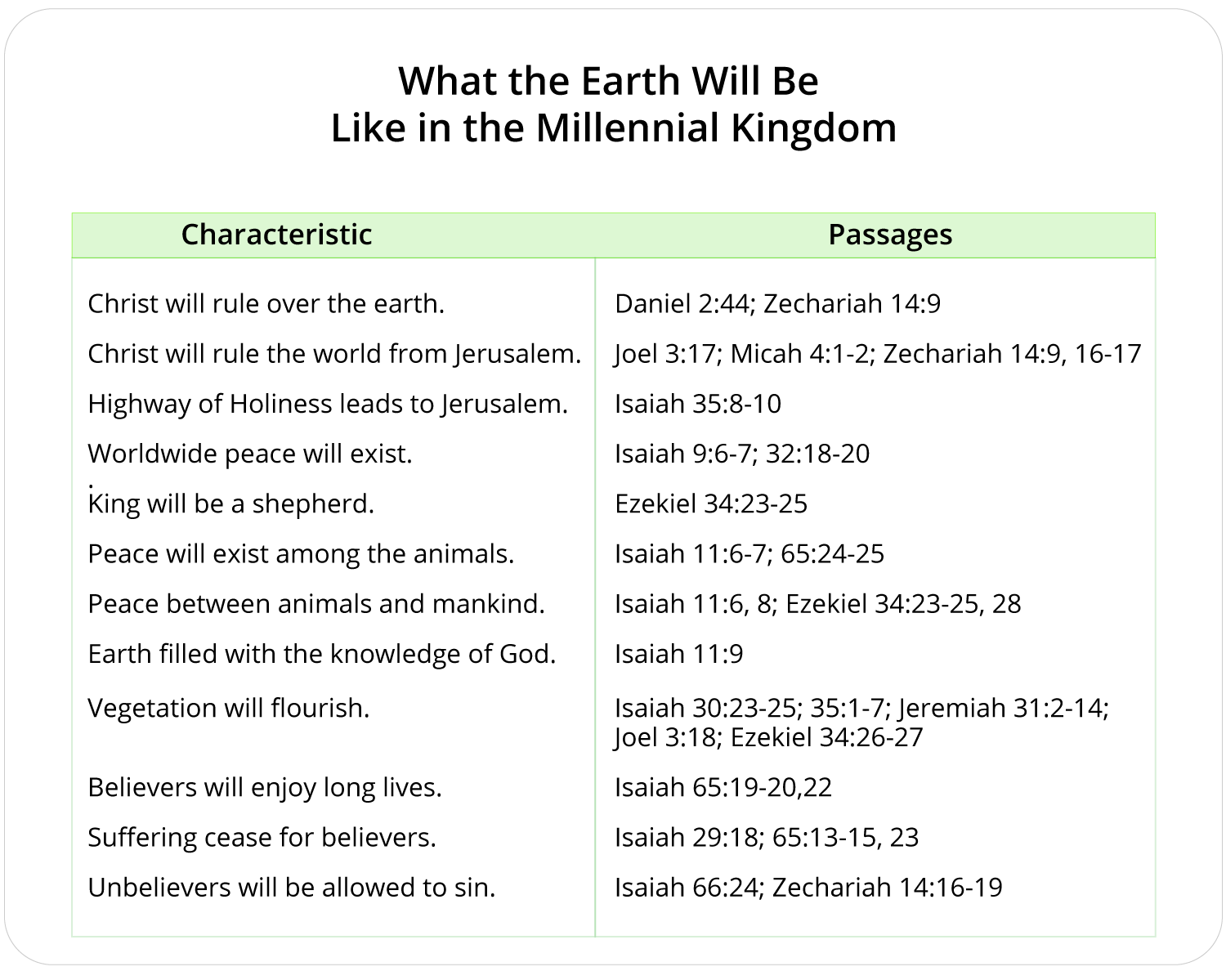
Chart From NeverThirsty
Ironic he gets so much right and yet misses that The Feast of Tabernacles fulfilled in the NEW JERUSALEM provides the living water. LOL
Arguments for Ezekiel’s Kingdom is entirely Spiritual Allegorical - all pointing to the FEAST of Tabernacles when JESUS CHRIST is literally with the Saints in Person REIGNING Supreme in Jerusalem Physically:
Ezekiel's temple of glory is Jesus, a truth revealed in the incarnation, proclaimed in Jesus' teaching, and made understandable by his resurrection [John 2:21-22]. Jesus inaugurated the fulfillment of Ezekiel's vision of a new temple in himself and in his people (the church)
E.W. Bullinger in his noted Companion Bible says of Ezekiel’s Temple or Sanctuary, that it is the palace or habitation of the Messiah in connection with “the city of the great King” (Ps 48:2; Matt 5:35) (Appendix 88, p. 126).
“These closing chapters [Ezek 40 through 48] describe the new temple and a new order of worship for Israel. Most important they conclude with the name of the city, [YHVH] Is There. This is the key for understanding this whole vision of Ezekiel, which is paralleled by Revelation 21:1–22:15.
As John has an angel guide to show him around his New Jerusalem, so Ezekiel has an angel to explain to him his temple vision. Though scholars vary in their interpretation, the temple is best interpreted symbolically, representing the worshiping community of the Messiah, during the church age, the Millennium, and climaxing in the world to come” (Spirit Filled Life Bible, notes on Ezek 40:1).
Here is a mind blowing study by this Scholar thirdmill.org. He even provides extensive biblical proof of how the detailed architecture descriptions of Ezekiel 40-48 are proven to be allegorical in nature pointing to Jesus Christ who came not to abolish the LAW but to FULFILL the LAW.:
Ezekiel's Vision of a New Temple (HTML) - Thirdmill
Ezekiel's Vision of a New Temple (HTML) (thirdmill.org)
Jesus Christ, the New Temple
https://shamelesspopery.com/jesus-christ-the-new-temple/
From Malachi we can say both why the Second Temple would be greater than the First, and how the Lord intended to fill His House with glory: by entering the Temple Himself: “Then suddenly the Lord you are seeking will come to His Temple; the messenger of the covenant, whom you desire, will come” (Malachi 3:1). It’s in Jesus Christ that God fulfills both these Second Temple prophecies, and the Temple Prophecies of Ezekiel.
He is referring to Ezekiel 47 and following. After all, Jesus has already told us what the true temple is when He declared, “Destroy this temple, and in three days I will raise it up” (Jn 2:19). As John makes crystal clear, “He spoke of the temple of his body” (Jn 2:21). So Jesus is declaring to all at the Feast of Tabernacles that Ezekiel’s vision is not a physical description of a stone building, but a spiritual description of the true temple, the Body of Christ. For the same reason, John says that Jesus “tabernacled” among us (Jn 1:14) when He became man. Paul makes the same connection, referring both to individual Christians and to the mystical Body of Christ as the temple (1 Cor 3:16-17; Eph 2:21).
the New Jerusalem - Literal Kingdom of God 1,500 cubic miles. Why the differences in measurements? Ezekiel 40-47 is the Temple Tabernacle that will no doubt be within the WALLS of the NEW JERUSALEM.
Ezekiel 40-47 Ezekiel’s Temple is the SPIRITUAL FULFILLMENT by Jesus Christ.
Before going into the details of why so many believe the literal temple of Ezekiel’s temple will be fulfilled in the Millennium please note that although there is a good amount of scripture evidence proving it was God’s ultimate plan the temple would end up spiritual - allegorical to fully represent JESUS CHRIST in fulfilling the FEAST OF TABERNACLES, It would have been a real literal fulfillment in the 2nd Temple IF Israel would have received Jesus Christ as their Messiah. See this comment:
Stock Exchange.Com
Bible Hermeneutics: By Dottard:
Therefore, Eze 40-48 is a prophecy of a restored Jerusalem temple following the Jews' return from Babylonian captivity. Unfortunately, the returned Jews did not return in the numbers that were hoped for and were not as faithful as they should have been (See the book of Nehemiah!)
Thus, the prophesied grand temple was never built; the sacrifices as predicted were never implemented; and when the "glory of the LORD" (Eze 43:1) was to come to this new temple, ie, the Messiah as king of restored Israel, He should have offered the prescribed sacrifices listed in Eze 34, 44, etc.
However, as recorded in the NT - the Jews were not faithful and Jesus, instead of coming to the temple and offering sacrifices, was rejected.
Matt 23:35-29 - And so upon you will come all the righteous blood shed on earth, from the blood of righteous Abel to the blood of Zechariah son of Berechiah, whom you murdered between the temple and the altar. Truly I tell you, all these things will come upon this generation.
O Jerusalem, Jerusalem, who kills the prophets and stones those sent to her, how often I have longed to gather your children together, as a hen gathers her chicks under her wings, but you were unwilling! Look, your house is left to you desolate. For I tell you that you will not see Me again until you say, ‘Blessed is He who comes in the name of the Lord.’”
Thus, the Jews and the Jewish temple were rejected because of their unfaithfulness. (See general principle in Eze 18 and Jer 18 about conditional prophecy.)
However, that does not prevent the Israelite sacrifices having some significance beyond the old Israelite economy as it pertains to the "New Covenant". See appendix below.
APPENDIX - Levitical Covenant Significance
Levitical Covenant: – Lev 1-9, 16, 21-27 , Num 3, 4, 8, 18, 25:10-13, Deut 33:8-11, Neh 13:29, Mal 2:4-8. This is an eternal covenant (Num 25:12, 13, Ps 106:30) of salt, Num 18:19.
The Levitical covenant is stated in Num 3:11-13, 25:12 where God takes the Levites (especially the line of Phineas as High Priest) instead of the all the firstborn of each family, thus changing the (informal) priesthood from the firstborn of each family to the (formal) priesthood of tribe of Levi. Several Bible writers refer to this Levitical Covenant including:
Neh 13:29 – “the covenant of the priesthood and the Levites”
Jer 33:18, 21 – “covenant with the Levitical priests.”
Mal 2:4-8 – “the covenant with Levi”
Num 25:10-13 – the eternal covenant of priesthood was also a covenant of peace and a covenant of “salt” (Num 18:19), ie, very solemn and eternal.
Isa 54:10 & Eze 34:25 also describes the covenant of peace with the Levites From other Bible passages we can see what the Levitical covenant was.
The purpose of the Levitical covenant was to teach and inculcate the plan of salvation (Deut 33:9, 10, Heb 9:8, 9, 11-14, 10:1-3, Col 2:16, 17). That is, it symbolically taught about salvation by grace through the coming Messiah via His substitutionary death in the place of the sinner. Thus, the sacrifices, Levites, priests and High Priest became a type of Jesus in various ways.
A promise by God to set them apart, ie, make them “holy” (Num 3:12, 13), to be a substitute for the first born in Israel, and to have the primary responsibility for caring for the sanctuary, its ritual services and sacrifices, maintaining and transporting its equipment. Ex 32:25-29. In this way, they became the priests of Israel. All these regulations were contained in Lev 1-9, 16, 21-27.
Thus, the Levites enjoyed a “blessed” (and privileged) status. Ex 32:29, Mal 2:5.
The book of Leviticus (and Num 1 & 18) sets out the responsibilities of the Levites in operating the ceremonial rites and sanctuary services and caring for the sanctuary equipment. See also Num 1:53, 18:2, Deut 10:8, 31:9, 25, Josh 3:3, 2 Sam 15:24, 1 Chron 15:26.
The token/sign (Heb: “oth”) of the Levitical covenant appears to have been the unleavened bread at the annual festival (Ex 13:6, 9, 16, Lev 24:8).
Jesus is the high priest of the New Covenant Heb 4:14-16, 5:10, 7:23-28, 8:1, 2, 9:1-28, 10:1-18. Thus, Jesus inherits and was the fulfilment of the Levitical Covenant (See Mal 3:1). Jesus did this in several ways as well such as:
Jesus was the fulfilment of what the sanctuary/temple typified, John 2:19-21, Heb 9:1-28, 10:1-18
Jesus represented the foundation of the temple as well, 1 Peter 2:4-8 (Compare Isa 28:16, Ps 118:22)
Jesus’ body was represented by the curtain in the temple, Heb 10:20.
Jesus was the bread of life, John 6:35, 41, 48 (compare Ex 25:23-30, Lev 24:8).
Jesus was the light of life, John 8:12, 9:5 (compare the lampstand Ex 25:31-39, Lev 24:3, 4, Isa 53:11, Ps 56:13, etc)
Jesus provides the water of life, John 4:13, 14 (Compare the laver Ex 30:17-21. See also 1 Cor 6:11)
Jesus is the promised seed of the woman Gal 3:16 (compare Gen 3:15, and the Abrahamic Covenant)
Jesus was the Passover Lamb and thus the promised Messiah, John 1:29, 1 Cor 5:7, 1 Peter 1:19 (compare Ex 12:1-14).
Jesus is the High Priest of the New Covenant in fulfilment of the Levitical covenant, Heb 4:14-16, 5:10, 7:23-28, because He was “pure, blameless, set apart” exactly as the Levites were. See also Heb 9:15, 12:24.
Jesus provided the blood of the new covenant of which the communion ceremony was to be a memorial, Matt 26:28, Mark 14:24, Luke 22:20, 1 Cor 11:25, Heb 13:20, 1 Peter 1:19 (compare Ex 24:5, 8).
Jesus was the anti-type of the “red heifer” (Num 19:1-10) and its associated ashes that “purify our consciences from works of death”, Heb 9:13, 14.
Jesus did not abolish the Israelite Covenant and Moral Law but came to fulfill them, Matt 5:17-20, Gal 3:21. The moral law still applies to Christians BUT Jesus fulfills the Levitical and Davidic covenants by being the eternal High Priest and the eternal King of the Kingdom of Heaven.
Follow
answered Dec 16, 2022 at 20:22

My Commentary:
I urge the reader to understand our roles in this realm as Ambassadors, As Priests after the Order of Melchizedek
Please read my study:
Come Meet My Kinsman Redeemer and knowing Melchizedek
Melchizedek, My Kinsman Redeemer (thethirdheaventraveler.com)
The Bride - The Wife - The Church - One in Israel - One in Christ (thethirdheaventraveler.com)
You dear Saint are an Ambassador appointed to be a Priest (thethirdheaventraveler.com)
The Shock and Awe of Paul in the book of Hebrews (thethirdheaventraveler.com)
Here’s commentary trying to prove the New Jerusalem remains in Heaven:
Chapter 21 - The "New" Heaven, the "New" Earth, and New Jerusalem
Revelation Chapter 21: New Jerusalem descends to the "New" Heaven and "New" Earth - Life in the millennial Kingdom of Elohim ("God")
Now, we have another time-sequence dilemma. The vast majority of Bible expositors state that the "new" heaven, the "new" earth, and New Jerusalem of Chapters 21 and 22 appear in eternity, following the Millennium. But, 21:27 seems to indicate the presence on the "new" earth of those whose names are not written in the Lamb’s Book of Life and who are not allowed to enter New Jerusalem. Could it be, in the same way Chapters 17 and 18 are parenthetical chapters giving more details about modern, prophesied Babylon, that Chapters 21 and 22 are also parenthetical chapters giving more details about the New Jerusalem of the Millennial Kingdom?
In fact, Isaiah, prophesying about 800 years before the Revelation was written, indicated exactly that scenario. He foretold that there will be “new heavens and a new earth” (Isaiah 65:17; 66:22) with a newly-created Jerusalem (Isaiah 65:18). And this is in the context of his description of the Millennium, during which,
I will rejoice in Jerusalem, and joy in My people; The voice of weeping shall no longer be heard in her, nor the voice of crying. No more shall an infant from there live but a few days, nor an old man who has not fulfilled his days; For the child shall die one hundred years old, but the sinner being one hundred years old shall be accursed. They shall build houses and inhabit them; they shall plant vineyards and eat their fruit. They shall not build and another inhabit; They shall not plant and another eat; For as the days of a tree, so shall be the days of My people, And My elect shall long enjoy the work of their hands. They shall not labor in vain, nor bring forth children for trouble; For they shall be the descendants of the blessed of [Yehovah], And their offspring with them. It shall come to pass that before they call, I will answer; and while they are still speaking, I will hear. The wolf and the lamb shall feed together, the lion shall eat straw like the ox, And dust shall be the serpent's food. They shall not hurt nor destroy in all My holy mountain," Says [Yehovah] (Isaiah 65:19-25). “And, it shall come to pass [in the "new" heavens and the "new" earth] that from one New Moon to another, and from one Sabbath to another, all flesh shall come to worship before Me," says [Yahovah]. “And they shall go forth and look upon the corpses of the men who have transgressed against me, for their worm does not die, and their fire is not quenched. They shall be an abhorrence to all flesh. (Isaiah 66:23-24)
All of this - death, the presence of sinners, childbirth, new moons and sabbaths, looking on the corpses of the dead with horror, and so forth - does not sound like the eternal state following the Millennium and the Final Judgment, does it? Let us see if Yehovah will further clarify the sequence of events as we go through Chapter 21 verse by verse:
21:1 Now I saw (a) a new heaven and a new earth, for the first heaven and the first earth had passed away. Also there was (b) no more sea.
a. “Heaven” in the Bible is not a monolithic term (cf. Genesis 1:1). It may refer to the sky (the earth’s atmosphere), space (beyond the earth’s atmosphere but within Earth’s solar system), outer space (beyond Earth’s solar system where the Oort Cloud of comets, stars other than Earth’s Sun, and other galaxies and celestial objects exist), or the dwelling place of the Most High Elohim (beyond His Creation). “Heaven” in the present context, since it is singular, seems to refer to the sky (the earth’s atmosphere) and all it contains. Also, it is difficult to conceive of Elohim creating a brand new Heaven where He dwells, isn't it? On first impression, it certainly seems that the "new" heaven and "new" earth are “brand new,” having totally replaced the heaven and the earth that were destroyed at the Final Judgment. But have they? The Greek word translated “new” here is kainos, which can mean a renewal, refreshing, or refurbishing of something that already existed. The basic components of Heaven and Earth will not be totally done away with until the Final Judgment but are just greatly altered and radically restored back to their Edenic state during the Millennium so that they are, in effect, “new” (cf. Ezekiel 36:35). The Greek word that is most often translated “brand new” or “recently born” is neos, as in 1 Corinthians 5:7. The difference in the two terms is subtle, and sometimes they are used interchangeably, but the point is that in this verse kainos can, and apparently does, refer to a renewal rather than to a total replacement of the first earth and heaven. All the prophecies of the Day of Yehovah and His wrath certainly seem to indicate tremendous changes in the topography of the earth and radical reparations that will have to be made to restore it to its Edenic state during the Millennium (cf. Revelation 16).
Perhaps the 30-day period foretold by Daniel (Daniel 12:11) that immediately follows the 1260 days of the second half of the Final Seven Years is the time period during which the wrath of Elohim will fall on the earth, totally altering its surface features (cf. 16:18-20). Then, perhaps, during the next 45 days (cf. Daniel 12:12), the renewed earth and renewed heaven will be formed, New Jerusalem will descend to Earth, and the Messianic Kingdom will be established. But that is all conjecture.
b. This verse also, on first impression, makes it seem that the earth and heaven of 20:11 are replaced by the "new" earth and "new" heaven because 20:13 states, “. . . the sea gave up the dead,” but this verse says there is no more sea. However, before the great flood during Noah’s time, the earth was not covered mostly by oceans and seas. During the Millennial Kingdom, it will apparently be the same. Apparently, as was stated in the commentary on 20:13, the term “sea” in that verse is symbolic for the masses of unsaved people, and does not refer to a literal sea.
21:2-4 Then I, John, saw the holy city, New Jerusalem, coming down out of heaven from [Yehovah], (a) prepared as a bride adorned for her husband. And I heard (b) a loud voice from heaven saying, "Behold, (c) the tabernacle of [Yehovah] is with men, and He will dwell with them, and they shall be His people. [Yehovah] Himself will be with them and be their [Elohim]. And [Yehovah] will wipe away every tear from their eyes; (d) there shall be no more death, nor sorrow, nor crying. There shall be no more pain, for the former things have passed away."
a. New Jerusalem is prepared for a renewed earth - an appropriate marriage.
b. We have learned that a voice from Heaven can be the voice of any heavenly being or group of beings - a living creature, the 24 elders, the multitude of redeemed Saints, or an angel - whereas a voice from the throne in Heaven is the voice of the Yehovah.
c. The Tabernacle (as opposed to the Temple) was the temporary dwelling place of Yehovah among the tribes of Israel. This may be a clue that the renewed earth will endure during the Millennium, until the Final Judgment, but is not eternal. The ultimate goal of Yehovah is for His Saints to be One in Him, as Yehovah the Father and Yeshua the Son are One, not just for Him to dwell among them (cf. John 17:21).
d. This is a glimpse of Timeless Eternity given personally by Yehovah. These promises are for those redeemed and glorified Saints who dwell in New Jerusalem, but not for those who, during the Millennium, dwell in the nations surrounding New Jerusalem, where there will still be sin, pain, sorrow, weeping, and death, although even that suffering will be very limited compared to pre-millennial history.
21:5-8 Then (a) He who sat on the throne said, "Behold, (b) I make all things new." And He said to me, "Write, for these words are true and faithful." And He said to me, (c) "It is done! I am the Alpha and the Omega, the Beginning and the End. (d) I will give of the fountain of the water of life freely to him who thirsts. He who overcomes shall inherit all things, and I will be his [Elohim] and he shall be My son. (e) But the cowardly, unbelieving, abominable, murderers, sexually immoral, sorcerers, idolaters, and all liars shall have their part in the lake which burns with fire and brimstone, which is the second death.”
a. Here we have an interruption in John’s vision of the renewed heaven, the renewed earth, and New Jerusalem. The One who sits on the throne, the Alpha and Omega, speaks to John directly.
b. He tells John that He is in the process of making all things new (which is what the Revelation is all about) and tells him to write what he hears, because the words are faithful and true.
c. What is done? . . . perhaps, with the completion of the events of Revelation, the reconciliation of His redeemed People, and the restoration of all that belongs to Him in Heaven and on the Earth to Himself (cf. Colossians 1:21; Ephesians 1:10). When Yeshua finished His work of redemption on the cross, He similarly announced, “It is finished” (John 19:30). The great accomplishment of the Messiah at His first coming was to redeem His People and establish the Kingdom of Heaven in the hearts of those who have accepted Him as Savior and Adonai ("my Lord") since that time. The great accomplishment at His second coming will be to restore His kingdom on Earth and all the people in it to Himself.
d. And the end result will be adoption as Sons of Yehovah, eternal life for those who thirst for it, and the inheritance of all "riches of glory . . . in [the Messiah Yeshua]" (Ephesians 1:18; Philippians 4:19) by those who overcome.
e. But "eternal" separation from Yehovah and destruction in the lake of fire (cf. Malachi 4:1-3) is the destiny of those who reject life in the Messiah and continue in the ways of the wicked. By the way, this mention of the lake of fire in the context of the description of the renewed heaven, renewed earth, and New Jerusalem is another strong indication that Chapter 21 is a parenthetical description of the millennial, earthly Kingdom of Elohim prior to the Final Judgment.
21:9-27 Then (a) one of the seven angels who had the seven bowls filled with the seven last plagues came to me and talked with me, saying, "Come, I will show you the bride, the Lamb's wife." And he carried me away in the Spirit to (b) a great and high mountain, and showed me the great city, the holy Jerusalem, descending out of heaven from [Yehovah], having the glory of [Yehovah]. Her (c) light was like a most precious stone, like a jasper stone, clear as crystal. Also she had (d) a great and high wall with twelve gates, and twelve angels at the gates, and names written on them, which are the names of the twelve tribes of the children of Israel: three gates on the east, three gates on the north, three gates on the south, and three gates on the west. Now (e) the wall of the city had twelve foundations, and on them were the names of the twelve apostles of the Lamb. And he who talked with me had (f) a gold reed to measure the city, its gates, and its wall. The city is laid out as a square; its length is as great as its breadth. And he measured the city with the reed: (g) twelve thousand furlongs. Its length, breadth, and height are equal. Then he measured (h) its wall: one hundred and forty-four cubits, according to the measure of a man, that is, of an angel. (i) The construction of its wall was of jasper; and the city was pure gold, like clear glass. The foundations of the wall of the city were adorned with all kinds of precious stones: the first foundation was jasper, the second sapphire, the third chalcedony, the fourth emerald, the fifth sardonyx, the sixth sardius, the seventh chrysolite, the eighth beryl, the ninth topaz, the tenth chrysoprase, the eleventh jacinth, and the twelfth amethyst. The twelve gates were twelve pearls: each individual gate was of one pearl. And the street of the city was pure gold, like transparent glass. (j) But I saw no temple in it, for the Lord [Yehovah] Almighty and the Lamb are its temple. (k) The city had no need of the sun or of the moon to shine in it, for the glory of [Yehovah] illuminated it. The Lamb is its light. (l) And the nations of those who are saved shall walk in its light, and the kings of the earth bring their glory and honor into it. Its gates shall not be shut at all by day (there shall be no night there). And they shall bring the glory and the honor of the nations into it. (m) But there shall by no means enter it anything that defiles, or causes an abomination or a lie, but only those who are written in the Lamb's Book of Life.
a. After John’s personal conference with Yehovah, one of the angels who poured out the bowls of wrath came to him, beckoning him to accompany the angel to a place where John would be shown “the bride, the Lamb’s wife,” who has been clearly identified in the Bible as Yehovah’s People, the redeemed Saints of Adonai, including the BBM (Before the Birth of the Messiah) Saints and the Followers of Yeshua (e.g., Isaiah 62:5; Ephesians 5:23; Revelation 19:7-9).
b. Now, the description gets mystical and highly symbolic. The Bride of the Messiah is New Jerusalem. Prophecy seems to indicate that there will be only one huge mountain on the earth (all others will have disappeared – cf. 16:20) during the Millennium, and that will be the mountain of the Lord, Mount Zion (Isaiah 2:3; Ezekiel 17:22-23; 20:40). Apparently, that will be the location to which New Jerusalem descends out of Heaven, for it is from there that King Yeshua will rule. The description of New Jerusalem is similar to Ezekiel’s prophetic description of the city (cf. Ezekiel 40-48).
c. Because human minds cannot begin to fully comprehend New Jerusalem, it is presented in images of the most fantastic, precious, valuable, beautiful objects known on the earth. Her light, reflecting the glory of Yehovah, is like a jasper stone (probably a diamond). Like the jasper stone, the Bride of the Messiah will not be the source of light in New Jerusalem, but will reflect the glory of Yahovah.
d. The twelve gates of the city, three on each side, each attended by an angel, each a having the name of a tribe of Israel written on it, were typified by the twelve tribes of Israel camped around the tabernacle (Numbers 2). Perhaps this symbolizes that the only entrance into New Jerusalem and the presence of Elohim is through Israel’s Messiah.
e. The city walls, which keep out intruders and protect the residents, are built on twelve foundation stones - Yeshua’s apostles. Members of the Assembly of Believers in Yeshua, the Bride of the Messiah, are told that they, as “living stones, are being built up [into] a spiritual house” (1 Peter 2:5), and also that the Messiah is the “chief cornerstone” (1 Peter 2:7). The Assembly of Believers in the Messiah is built on the foundation of the prophecies and doctrines of the prophets and apostles (1 Peter 2:20). In some wonderful, mystical way, New Jerusalem will literally be the Assembly of Believers, the Bride of the Messiah.
f. As was mentioned in the commentary on 11:1, measuring the Temple was symbolic of preserving Israel through the Wrath of Elohim. But that was done with a flimsy cane reed. Now, New Jerusalem is measured with a golden reed, indicating eternal preservation of a highly-valued object - the City or People of Yehovah, the Bride of the Messiah.
g. In Scripture, twelve seems to be the number that represents Yehovah’s people: twelve tribes of Israel, twelve apostles; and 1,000 is the number of completion or fullness, as in 144,000 of Israel (12,000 cubed). New Jerusalem, the Bride of the Messiah, is a complete cube, 12,000 furlongs (1,500 miles) in circumference - the perfected, completed City of Elohim. If this distance is literal, the city is approximately 375 miles on each side and in height - plenty of room for millions of glorified individuals who are not limited by gravity. But that incidental observation is not important; the symbolism of perfection and completeness is what is important.
h. The height of the wall (which is identified with the leaders of Yehovah’s People: its gates with the patriarchs and its foundation stones with the apostles) is the perfect height (as is indicated by the fact that its height is the measure both of a man and an angel) to protect and preserve Yehovah’s people. Its height, 144 cubits, is the number of the representatives of ancient Israel and the Assembly of Believers in Yeshua multiplied together, which cubes or perfects the number. In other words, it takes both Yehovah's BBM People Israel and His ABM People the Believers in Yeshua perfectly combined to complete the Bride of the Messiah, New Jerusalem - another indication that the Revelation is written to both Jews (Israelites) and followers of Yeshua ("Christians").
i. We will not, for fear of missing the beauty of the forest by focusing on the individual trees, attempt to read meaning into every component of New Jerusalem. If we can just list each component and visualize the incredible combined beauty of those components, perhaps Yehovah will give us an inkling of the awesome, incomprehensible beauty of the actual New Jerusalem: The 144-cubit (216-foot) wall is brilliantly-luminescent, crystal-clear jasper (diamond?); the entire city is gold so pure that it is transparent; the twelve foundations of the wall (the apostles) are adorned with breathtakingly beautiful, precious stones: jasper, sapphire (blue), chalcedony (a greenish emerald), emerald (bright green), sardonyx (red and white), sardius (bright red), chrysolite (golden yellow), beryl (bluish green), topaz (yellowish green), chrysoprasus (apple green), jacinth (blue), and amethyst (violet and purple); each gate is one huge pearl engraved with the name of a tribe of Israel; and the street of the city is pure, transparent gold.
j. This confirms that the renewed heaven and the renewed earth, in which Elohim “tabernacles” with His People, are temporary. Mystically again, there is no temple in New Jerusalem, because Elohim the Father and Elohim the Son are, as One, its Temple. In New Jerusalem, Yahovah no longer dwells in the Saints, who are the temple of the Holy Spirit (1 Corinthians 6:19), but the Saints are One in Him (cf. Romans 12:5).
k. The glory of Yehovah provides perfect light for New Jerusalem; there are no sun, moon and stars, and hence, no night there.
l. In fact, the light of New Jerusalem, in which the people of the earth shall walk, shall provide light for the whole earth. And the “kings” of the earth shall bring their glory into the city. If this is during the Millennium, as it seems to be, the “nations” outside the city gates are not-yet-glorified human beings - the people of the nation of Israel plus those of the Gentile nations who survived the Final Seven Years. And walking in the light probably symbolizes walking in the Spirit, as it does for Believers today (cf. John 8:12; Ephesians 5:8; 1 John 1:7; Galatians 5:25), except on a much grander, more general scale. The ones who do not walk in the light will be the exceptions. During the Millennium, all nations will be ruled by the apostles and other glorified saints who rule with the Messiah from New Jerusalem, and they will glorify Yehovah by coming into His presence in New Jerusalem and worshiping Him. This is a fulfillment of BBM prophecy, for, as the psalmist declared, “All nations whom You have made shall come and worship before You, O [Yehovah], and shall glorify Your name” (Psalm 86:9). What a wonderful world it will be!
m. However, those who are not saved, whose names are not written in the Lamb’s Book of Life, will not be allowed to enter New Jerusalem. These, apparently, will be those of the nations who, although allowed to enter the millennial kingdom, do not totally submit themselves to the lordship of the Messiah and are deceived and reject His lordship after Satan is released at the end of the Millennium. This seems to confirm that the renewed heaven, the renewed earth, and New Jerusalem are the heaven, the earth, and Jerusalem of the millennial Kingdom of Elohim ("God") because, in (true) eternity, there will be none whose names are not written in the Book of Life.
Please click one of the following links to navigate this site:
Return from Chapter 21 to the verse-by-verse commentary on Revelation page.
Return to the Revelation Understood! commentary home page.
Gentile nations as He did with Sodom and Gomorrah.
Conclusion
At the Second Coming of Jesus to begin His millennial reign, major changes will take place on the earth. Gentile believers will not only live in the Millennial Kingdom, but they will rule with Christ. They will experience God’s blessing and will worship the Lord at the Temple in Jerusalem. By contrast, unbelieving Gentiles will be cast off the earth, and, in some cases, their land will be wasted because of what they have done to and with the clews throughout history.
This prospect should challenge us to turn to the Lord for salvation, live for Him, and serve Him with all our hearts while we have time. It should also give us a burden for the Jewish people. What we do now will affect our rewards and position in the Millennial Kingdom of Christ.
To fully comprehend Jesus Fulfills the LAW and is the TABERNACLE within The New Jerusalem that comes down from Heaven when He does study the Fullment of the Feast of Tabernacles:
The Feast of Tabernacles
John 7:37 sets the teaching of Jesus about “living water” on the “last day, the great day of the feast.” “last, the great day” is to the seventh day* of the Feast of Tabernacles (which came to be called Hoshana rabba)
Suc·coth
[ˈso͞oˌkōt]
NOUN
Sukkot (noun)
a major Jewish festival held in the autumn (beginning on the 15th day of Tishri) to commemorate the sheltering of the Israelites in the wilderness. Also called Feast of Tabernacles See also succah
Official nameHebrew: סוכות or סֻכּוֹת · ("Booths, Tabernacles")
TypeJewish, Samaritan
SignificanceOne of the three pilgrimage festivals
See more
Sukkot is a Jewish festival that celebrates the gathering of the harvest and commemorates the miraculous protection God provided for the children of Israel when they left Egypt1. It is also known as the Feast of Tabernacles, which symbolizes God’s protection and provision2. The festival is celebrated by dwelling in a foliage-covered booth (known as a sukkah) and by taking the “Four Kinds” (arba minim), four special species of vegetation1. On a deeper level, Sukkot celebrates the security God provided for our ancestors in the least secure of places3.
Learn more:


Note: The seventh day is the Day of Rest the Beginning of the MILLENNIUM. It is here that most scholars agree that the FEAST of TABERNACLES is fulfilled at the Beginning of the Millennium.
Very important note: Once you connect the dots between the FEAST OF TABERNACLES true meaning (COME MEET MY KINSMAN REDEEMER MELCHIZEDEK ETC.) and the 7th DAY (7th day of rest) you will realize how allegorical in nature Jeremiah’s temple truly is.
The Feast of Tabernacles is a seven-day feast that pictures the 1,000-year reign of Jesus Christ on earth after His second coming23. This period is often called the Millennium, which simply means "1,000 years"1. The Feast of Tabernacles has its typical fulfillment in the Millennium, when Israel finally will enjoy safe territorial boundaries and will be a blessing and witness to the Gentile nations2. After the great war of the end times and the second coming of Yeshua, those who survive of all the nations will go up to Jerusalem to worship and celebrate the Feast of Tabernacles4.
Learn more:
1.2 israelmyglory.org
+1 more
Sukkot (Hebrew: "Feast of Booths," "Feast of Tabernacles," or "Feast of the Ingathering") is a Jewish holiday taking place on the 15th day of the month of Tishri, five days after Yom Kippur (in September or October). Originally an agricultural festival meant to thank God for a successful harvest, Sukkot is a joyous 7 to 8 day celebration with a wide variety of accompanying traditions. Most notable of these is the construction of a sukkah (Hebrew: "booth"), a small hut representing both the dwellings that ancient farmers would live in during the harvest months and also the temporary dwellings used by Moses and the Israelites as they wandered in the desert for 40 years.[1]
The Feast of Tabernacles, or Sukkot, is the third great annual pilgrimage festival when the Jewish people gather together in Jerusalem not only to remember God’s provision in the Wilderness but also to look ahead to that promised Messianic age when all nations will flow to Jerusalem to worship the Lord.
Why We Celebrate the Feast of Tabernacles - ICEJ

www.icej.org/understand-israel/biblical-teachings/why-we-celebrate-the-feast-of …
Of the seven feasts of the Lord, only the Feast of Tabernacles has its typical fulfillment in the Millennium, when Israel finally will enjoy safe territorial boundaries and will be a blessing and witness to the Gentile nations (Gen. 12:2–3; 15:18; Isa. 2:2–4; 60:3; Jer. 32:37–41; 33:16; Ezek. 37:25–28).
Tabernacles in the Millennium – Israel My Glory

israelmyglory.org/article/tabernacles-in-the-millennium/
The Gentile nations along with the Jews will be coming up to Jerusalem to keep the Feast of Tabernacles (aka Booths), (Zechariah 14:16) because the spiritual completion of this festival, which is, yet unfulfilled, will finally be completed in the Millennium. In other words at no other time in the past was this Feast’s spiritual completion fulfilled. It will take place in the Millennial Kingdom.
Tabernacles had characteristics, which other feasts did not have. For example it was the harvest festival of joy and thanksgiving. It was a celebration not only of the full ingathering of the harvest work of the Israelis in the field, but also of the fruit and of the vintage. It is interestingly therefore the only one characterized as “the Feast of Ingatherings” (Exodus 23:16; 34:22; Deuteronomy 16:13).
It does appear that from Ezekiel Chapters 44-46 there is some confusion of exactly which Festivals of the original seven will be carried out in the Millennium. In fact this obscurity has caused some exegetes to completely avoid it including Rashi. Some think that since Passover and Booths are specifically cited in Ezekiel and Zechariah that they are the only ones to be performed during the Millennial Kingdom.
End quote:
Jewish Festivals in the Millennial Kingdom? - Theology in Perspective (doctorwoodhead.com)
Because of what Jesus said in Matthew 26:29, It is proof of Ezekiel’s take on Festivals:
Matthew 26:29
“But I say unto you, I will not drink henceforth of this fruit of the vine, until that day when I drink it new with you in my Father's kingdom.”
King James Version (KJV)
John 7:37
“In the last day, that great day of the feast, Jesus stood and cried, saying, If any man thirst, let him come unto me, and drink.”
King James Version (KJV)
John 7:38
“He that believeth on me, as the scripture hath said, out of his belly shall flow rivers of living water.”
King James Version (KJV)
My comment: It is essential that in your Bible study time to read and meditate on what happened to Jesus in the remaining verses of John Chapter 7 verses 39-52. Then read and meditate on John Chapter 8, the woman taken in adultery and when Jesus states in 8:12:
I AM THE LIGHT OF THE WORLD
John 8:12
“Then spake Jesus again unto them, saying, I am the light of the world: he that followeth me shall not walk in darkness, but shall have the light of life.”
King James Version (KJV)
LIVING WATERS
LIGHT ETERNAL
The background of the ceremonies of light at the Feast of Tabernacles led us to see a connection between the primordial light from the Temple and Jesus. The tradition of the Shekinah (the glory of God’s presence) “tabernacling” with humans was seen as being fulfilled by Jesus. The festival imagery of perpetual light, perhaps based on Zech. 14:6, could be connected to Jesus and the beginning of the Messianic Age. The story of the man born blind (Jn. 9:1-41) appears to be a dramatization of the water and light themes of chapters 7 and 8. The themes of identity, witness, and judgment from chapters 7 and 8 seem to be treated as well. In the story of the man born blind, witness is given to the identity of Jesus as creator, revealer, savior, and Messiah, and the opponents of Jesus are seen to be bringing judgment upon themselves. John seems to be telling his readers that the themes associated with the Feast of Tabernacles, discussed in chapters 7 – 9 of his Gospel, are fulfilled in Jesus.
The essential element of Ezekiel's vision is that God is present and will dwell among his people forever. The book of Ezekiel ends with the statement, "the name of the city from that day shall be, 'The Lord is there'" (Ezek 48:35). That is fulfilled in the New Jerusalem of Revelation 21-22:
Ezek 43:7-9 twice says "I will dwell among them forever." In the Greek OT, the root for "dwell" in Ezek 43:7 is "tabernacle." Rev 21:3 indicates that the New Jerusalem is the consummation of all prophecy, including Ezekiel's vision, by echoing Ezek 43:7, 9 and twice saying "the tabernacle of God is among men" and "He will dwell among them." Also, three times Rev 21:3 says that God will be "among" his people.
Ezekiel's Vision of a New Temple (HTML) (thirdmill.org)
Brown calls attention to a “replacement” motif prevalent in Johannine theology whereby Jesus replaces Jewish institutions. Jesus is the real Temple; not the Temple altar but Jesus himself is consecrated by God; the Spirit which he gives will replace the necessity of worshipping at Jerusalem; his doctrine and his flesh and blood will give life in a way that the manna associated with the exodus from Egypt did not; and at Tabernacles, not the rain-making ceremony but Jesus himself supplies the living water; not the illumination in the Temple court but Jesus himself is the real light (Brown:104). All rituals and modes of worship, even those of the Feast of Tabernacles (the Temple feast par excellence) are fulfilled in Jesus. John appears to be indicating that all of the eschatological and messianic hopes of the people of God, as pictured in the imagery of the Feast of Tabernacles, are now fully realized in Jesus.
https://archive.gci.org/articles/imagery-of-the-feast-of-tabernacles-in-the-gospels-chapter-4/
My comment: It sickens me how so many are deceived by thinking the church is floating around in the clouds while Jesus and JEWS (only) are reigning with Jesus in the New Jerusalem. Note: Some scholars at least try to fudge factor, hedging their bets to say the New Jerusalem floats around in the sky while the living human inhabitants are on earth.
Here’s a quote from Grace Through Faith: Although he correctly understands the use of an interlude - he refers to it as a parenthetical pause - he believes the New Jerusalem hovers over the earth which is not biblical. This can not be harmonized with at least 3 significant verses of scripture; e.g., Revelation 5:10, Daniel 7:18, 27, etc.
When Does The New Jerusalem Appear? – Grace thru faith
People who think the New Jerusalem doesn’t appear until the end of the Millennium don’t realize that Rev. 20:7-15 is a parenthetical insert John used to carry his discussion on the destinies of Satan and the unsaved to its ultimate conclusion. Then in Rev. 21 he returned to the beginning of the Millennium to describe the New Jerusalem. The clue we get to confirm this is he opened with the same language Isaiah used to discuss Israel’s Kingdom Age on Earth (Isaiah 65:17-25).
At the rapture of the Church the Lord will take us to His Father’s house to be with Him where He is (John 14:2-3). 1 Thes 4:17 says once we go there,we’ll always be with Him. Rev. 21:2 shows the New Jerusalem coming down out of Heaven and goes on to describe an entity far too big to be located on Earth. It must only come to Earth’s proximity.
In Matt. 24:29 Jesus said the Sun and Moon would no longer shine after the end of the Great Tribulation. Rev. 21:22-27 describes the nations walking by the light of the New Jerusalem. After the 2nd Coming the New Jerusalem will replace the Sun as Earth’s source of light.
Rev. 21:22-27 also shows the Kings of Earth bringing their splendor to the New Jerusalem, but says nothing impure can ever enter it, only those whose names are written in the Lamb’s Book of Life, which is a description of the Church.
When humans enter this earthly tabernacle, they are meant to realize they’re inhabiting two spaces at once, both heaven and earth. Every element of the tabernacle structure represents some element that would draw people back to the Eden narrative, from its three-tiered structure that mimicked the ancient Hebrew conception of the garden, to the cherubim carved by its entrance, to its furniture that represented different elements of the garden.
In a way, when we see moments in the Bible where a place represents Eden, this is actually Eden reappearing. Eden isn’t just a place where heaven and earth symbolically meet—it’s a place where literally heaven and earth are one, which is why it rematerializes in other geographic locations throughout the story of Scripture. It exists in such a way that it can touch down in
Certain features of Ezekiel's vision show that it always was intended to be symbolic and heavenly, not physical, in nature
The introductory formula (Ezek 40:1-2)
The introduction in Ezek 40:1-2 contains three elements: (1) reference to a specific date when the experience occurred; (2) a statement that "the hand of the Lord was upon me"; and (3) a statement that he saw "visions" The only other places in Ezekiel where that three-fold introductory formula occurs are in Ezek 1:1-3 and 8:1-3. In both of those other cases, the vision which Ezekiel saw was of a heavenly temple (i.e., God's dwelling place in heaven), not an earthly one. The heavenly temple is explicitly clear in Ezek 1:1-28 where the focus is exclusively in heaven.
In Ezek 8:1-11:23 the vision is of the heavenly presence that is linked to God's earthly presence with his people. Ezekiel saw the glory of God (8:4). However, Ezekiel then saw the abominations which were being done in the physical temple (8:5-17). Therefore, the glory of God began to leave the physical temple (9:3). The scene then shifts to the heavenly temple (10:1-22), and the glory of God completes his departure from the physical temple (10:4; 11:22-23). God's presence is still with the faithful exiles in Babylon (11:16), who are the true earthly temple, even though the physical temple building had been destroyed by the Babylonians.
The river (Ezek 47:2-12)
In Ezekiel's vision, the river must be symbolic and supernatural because even though no tributaries are mentioned, the water gets progressively deeper, from a trickle to a river that could not be forded (47:2-5). Unlike a natural, earthly river, it makes salt water fresh rather than vice verse (47:6-12).
The significance of the first coming of Christ
Although Ezekiel wrote using language and imagery that his immediate audience could understand, in light of the coming of Christ Ezekiel's temple could not possibly represent a literal, physical building to be constructed in the future.
Throughout his vision Ezekiel describes animal sacrifices which are said to have an "atoning" purpose and effect (Ezek 43:13-27; 45:15-25). Such sacrifices could not possibly truly be atoning sacrifices, since that would reverse redemptive history and deny the efficacy and sufficiency of Christ's once-and-for-all sacrifice of himself, contrary to Heb 9:11—10:22. That also would return to the "shadows" in place of the substance and reality (see Col 2:16-17; Heb 8:1-10:22).
To take "literally" (i.e., physically) Ezekiel's portrait of Jerusalem as the center of the world's worship (Ezekiel 47-48), where non-Israelites are excluded from the temple (Ezek 44:6-9), likewise completely reverses what Christ has done. Jesus eliminated the requirement that worship be conducted at some special place (John 4:21, 23) and eliminated the distinction between Jews and Gentiles among God's people. 6
To say that the sacrifices are simply "memorials" of Christ's sacrifice means that there is likewise no reason to take the temple itself "literally" (i.e., as a physical structure). To view the sacrifices referred to by Ezekiel as "memorials" also would dishonor Christ since the only memorial that Christ himself gave to "memorialize" his redemptive work was the Lord's Supper, not a return to OT sacrifices (Luke 22:14-20; 1 Cor 11:23-26). 7 David Holwerda concludes:
The essential truth of Ezekiel's temple has become reality apart from a building of stone. That may seem like a surprising twist in the fulfillment of prophecy, but with Stephen and the prophet Isaiah we should know that "the Most High does not dwell in houses made with human hands" (Acts 7:48). God dwells in Jesus and in us (John 14:23), and the reality of Ezekiel's temple exists throughout the world… Jesus did not come to turn Ezekiel's architectural blueprints into the most magnificent temple ever constructed by human hands. That the Messiah was supposed to do this was the misunderstanding of Jesus' opponents, a misunderstanding shared by his own disciples until the resurrection opened their minds. Ezekiel's temple of glory is Jesus, a truth revealed in the incarnation, proclaimed in Jesus' teaching, and made understandable by his resurrection [John 2:21-22]. 8
Jesus inaugurated the fulfillment of Ezekiel's vision of a new temple in himself and in his people (the church)
Ezekiel's vision showed the "glory of the Lord" filling the temple, and would dwell among his people forever. 9 John uses language about Jesus reminiscent of Ezekiel: "And the Word became flesh, and dwelt among us, and we saw his glory, glory as of the only begotten from the Father, full of grace and truth." 10 Jesus said that, through the Holy Spirit, he would dwell in his people and would always be with us. 11 Fulfillment of that promise began on the Day of Pentecost when the disciples were filled with the Holy Spirit (Acts 2:1-21).
Ezekiel's vision showed a river of life-giving water flowing out from under the temple (Ezek 47:1-12). Since Jesus is God's true temple (see John 2:18-22), he is the true source of life-giving water. In John 4:10-14, he told the Samaritan woman that he is the source of eternal, "living water." In John 7:37-39, Jesus said, referring to his giving the Holy Spirit, "If anyone is thirsty, let him come to me and drink. He who believes in me, as the Scripture said, 'From his innermost being will flow rivers of living water.'" Since no OT text explicitly says "from His innermost being will flow rivers of living water," it is likely that "a multiple allusion to pertinent scriptures is in mind. Those would be passages that were of prime significance for the meaning of the festival and were read at it." 12 Included among these was Ezek 47:1-11, the flowing of the river of living water from the temple in the kingdom of God. In other words, Jesus connects the eschatological temple of Ezekiel with himself as the new temple. Hence, the waters flow not from a physical temple in Jerusalem but from Jesus himself. The church is the channel of the life-giving water whose source is Jesus.
Ezekiel's final vision builds upon and consummates what he earlier had said in Ezek 37:26-28. Just as that passage twice said that God would "set up a sanctuary in their midst forever," so Ezek 43:7-9 twice says "I will dwell among them forever." In 2 Cor 6:16-7:1 Paul linked the promises of Lev 26:11-12, 2 Sam 7:14, and Ezek 37:27 and showed how fulfillment of those promises was inaugurated in the church.
The New Jerusalem (Rev 21:1—22:5), not a physical building to be constructed on the earth in the future, is the consummation of Ezekiel's temple (Ezekiel 40-48) and is the true reality to which Ezekiel's vision pointed
In Ezek 40:2, Ezekiel was taken to a "very high mountain" where he saw a "structure like a city." There are no "very high mountains" in or around physical Jerusalem. The fact that he saw a structure "like" a city suggests that Ezekiel is entering into "the realm of symbolic geography of heaven and earth that pertains to eschatological conditions." 13 That is confirmed by Rev 21:10 which parallels Ezekiel's language in describing the New Jerusalem. That passage says an angel "carried me away in the Spirit to a great and high mountain, and showed me the holy city, Jerusalem, coming down out of heaven from God."
In Ezekiel's vision both the temple and the city are described as square. 14 The identification of Ezekiel's city with the New Jerusalem is confirmed by Rev 21:16 which describes New Jerusalem as "laid out as a square."
The essential element of Ezekiel's vision is that God is present and will dwell among his people forever. The book of Ezekiel ends with the statement, "the name of the city from that day shall be, 'The Lord is there'" (Ezek 48:35). That is fulfilled in the New Jerusalem of Revelation 21-22:
Ezek 43:7-9 twice says "I will dwell among them forever." In the Greek OT, the root for "dwell" in Ezek 43:7 is "tabernacle." Rev 21:3 indicates that the New Jerusalem is the consummation of all prophecy, including Ezekiel's vision, by echoing Ezek 43:7, 9 and twice saying "the tabernacle of God is among men" and "He will dwell among them." Also, three times Rev 21:3 says that God will be "among" his people.
Ezek 43:7 says, "This is the place of my throne." Rev 22:1, 3 both state that "the throne of God and of the Lamb" will be in New Jerusalem.
Ezekiel's temple and the New Jerusalem both have twelve gates in the same configuration: three on the north; three on the east; three on the south; three on the west. 15 Further, the apostles and the tribes of Israel are described as part of the very structure of New Jerusalem itself: the apostles are the foundation (Rev 21:14); the twelve tribes are the gates (Rev 21:12-13). "The integration of the apostles together with the tribes of Israel as part of the city-temple's structure prophesied in Ezekiel 40-48 confirms … that the multiracial Christian church will be the redeemed group who, together with Christ, will fulfill Ezekiel's prophecy of the future temple and city. This is in line with other NT passages in which the whole covenant community forms a spiritual temple where God's presence dwells (1 Cor. 3:16-17; 6:19; 2 Cor. 6:16; Eph. 2:21-22; 1 Pet. 2:5)." 16
Ezekiel's temple is at the center of everything. In New Jerusalem, there is no physical temple building "for the Lord God the Almighty and the Lamb are its temple" (Rev 21:22). Thus, the true temple—God and the Lamb—is now central. "The equation of God and the Lamb with the temple approaches closely the essence of the Ezekiel vision, which is God's glorious presence itself (e.g., 48:35, 'the name of the city' is 'the Lord is there'). All that Israel's old temple pointed to, the expanding presence of God, has been fulfilled in Revelation 21:1—22:5, and such a fulfillment has been anticipated within Ezekiel 40-48 itself." 17
Ezek 47:1-12 describes a river flowing from out of the temple which is healing and life-giving. Rev 22:1-2 uses the same imagery and applies it to the New Jerusalem. The identification of the river in Ezekiel's vision with the river in the New Jerusalem is corroborated by Ezek 47:7, 12 which says that there were trees on both banks of the river. That parallels Rev 22:2 which similarly says that the tree of life was "on either side of the river." In both cases the trees are said to bear fruit (Ezek 47:12; Rev 22:2). Further, in both cases the leaves of the trees are "for healing" (Ezek 47:12; Rev 22:2).
Ezekiel's temple would only be a reality for those who had put away their abominations and sins (Ezek 43:6-9). Echoing Ezek 43:6-9, Rev 21:8, 27 say that "nothing unclean, and no one who practices abomination" will be in the New Jerusalem. That shows that Ezekiel's temple could only be referring to people who are "in Christ." Just as Christ inaugurated his kingdom and forever forgave sins at his first coming, so the New Jerusalem forms the consummation of Christ's kingdom, in which sins are forever eliminated.
Ezekiel's Temple: conclusion
Many would see Ezekiel's expansive vision of the Temple (chs. 40-48) as encouraging a belief that there will be an end-time Temple matching Ezekiel's prophetic description. Yet a biblical theologian cannot approach this prophecy without noting the way in which this prophecy is understood by the New Testament writers. Ezekiel's imagery of the river flowing from the Temple (Ezek. 47:1ff) reappears twice in the New Testament. In John 7:37-9 the 'rivers of living water' flow from Jesus himself; meanwhile in Revelation the 'river of the water of life' flows through the middle of the New Jerusalem (Rev. 22:1ff). These two writers have consciously drawn upon Ezekiel's prophecy and applied it to Jesus and the heavenly Jerusalem. As a result, they were presumably not expecting Ezekiel's prophecy to be fulfilled literally at some future point in a physical Temple. Instead this prophecy became a brilliant way of speaking pictorially of what God had now achieved in and through Jesus. Paradoxically, therefore, although Ezekiel's vision had focused so much upon the Temple, it found its ultimate fulfillment in that city where there was 'no Temple', because 'its Temple is the Lord God Almighty and the Lamb' (Rev. 21:22). 18
Ezekiel's Vision of a New Temple (HTML) (thirdmill.org)
All this shows two groups of humans, the nations of Earth still in their impure natural state, and the perfected Church, living nearby but protected from impurity, during the Millennium.
The temple in Ezekiel's vision is interpreted in different ways by different scholars and Christian interpretations123. Some interpretations include:
It is the temple that Zerubbabel should have built.
A literal temple to be rebuilt during the millennial reign of Christ.
A temple which is symbolic of the worship of God by the Christian church today.
A symbol of the future and eternal reign of God.
It is best interpreted symbolically, representing the worshiping community of the Messiah, during the church age, the Millennium, and climaxing in the world to come2.
It was intended to depict the perfection of Yahweh worship under the new covenant3.
The Millenial Reign does not require temple sacrifice and since Jesus Christ is literally on earth there is a preponderance of scriptural evidence that the law has been fulfilled and now it is all spiritual THE KINGDOM OF GOD IS WITHIN YOU for
Spiritual reasons.
Quote:
The Prophet Ezekiel, whose Hebrew name means “God Strengthens,” was the fourth of the five Major Prophets from Isaiah to Daniel. He was exiled to Babylon in 597 BC, and his ministry began five years later when he was 30 years old. He is believed to have prophesied from about 592 to 570 B.C., almost a quarter-century, between and overlapping the lives of the prophets Jeremiah and Daniel. Ezekiel was married, in fact his wife died as a sign from God on the day the siege of Jerusalem began. He says, “So I spake unto the people in the morning: and at even my wife died;” (24:18).
In the last nine chapters of his book, he gives an elaborate vision of a restored land and temple. It is popularly referred to as “Ezekiel’s Jerusalem Temple.” Yet the Bible indicates that it would not be placed at the site of the old Jerusalem Temple Mount, nor would the Temple be located in the city.
The Temple was not in “the city.”
Ten times in chapter 48 Ezekiel uses the term “the city” (Hebrew, iyr Strong’s #H5892). The Biblical Illustrator says, “Ezekiel does not think that the temple should be in the city, and he separated them by a distance of about three miles. The city is about two miles square. It has land on either side of it which is to support the people. Ezekiel makes no provision for the growth of the city, nor for the increase of the Levites, nor for the priests; there they are and they are going to abide forever.”
Dr. B.H. Carroll commented, “Our [Dispensationalist] brethren believe …that Christianity must revert back to Judaism with Jerusalem as its center. To me it is unthinkable that our gospel with its worldwide vision and mission can become so cabbined, cribbed, coffined, and confined that it will be shut up to Palestine and to Judaism. That would be an unthinkable anticlimax.”
Ezekiel actually places the Temple about 3 miles distant north of the city, so that it cannot be said to be the “Temple of Jerusalem.” A more accurate description would be “the Temple of the Terumah,” or “the Temple of the Oblation,” as we will discuss shortly.
Reformation scholar and martyr Matthew Poole, who was a forefather of the late respected 19th century Detroit Anglo-Israel pastor William Henry Poole, wrote that Ezekiel’s vision showed “the proportion the city might have been built to, if the sins of the Jews had not prevented.” This is key! The fulfillment of Ezekiel’s vision was dependent upon the repentance of those exiled for their manifold sins, but when they did not repent the wonderful offer of a restored land and temple was null and void.
The location was not in Jerusalem.
It is an interesting fact that in all nine chapters of Ezekiel’s vision, there is never any mention of the word, “Jerusalem.” This is all the more surprising because it seems that everyone calls it “the Jerusalem Temple.” Instead, it is referred to again and again a dozen times vaguely as “the city,” and ten times in chapter 48 alone. It is not until the very last verse in the Book of Ezekiel, chapter 48 verse 35, that he finally gives us the name of “the city,” and it is NOT Jerusalem! He says, “…the name of the city…shall be, The LORD is there,” in Hebrew, “Jehovah Shammah,” and the plain fact is that it is not Jerusalem, nor is it located at the site of the old Jerusalem! How do we know where it is located?
In Ezekiel’s vision, very close to the middle of the land between the 7 northern and 5 southern tribes, about 30 kilometers north of Jerusalem, is a large complex of sacred buildings called “the Sacred Grant” (Ferrar Fenton), called “the Oblation” in the KJV, “portion” in both the Amplified and the Protestant Reformation’s Miles Coverdale translation of 1535, “holy offering” in the Complete Jewish Bible, “holy heave-offering” in Darby, “whole offering” in the LXX, “holy portion” in Rotherham, “set-apart contribution” in the Scriptures Version, “the heave-offering” in Young’s Literal Translation; “the firstfruits” in Douay-Rheims. So there is a lot of different terminology used to describe it. The Hebrew word is “TERUMAH,” Strong’s H8641, meaning a present offered up, heave offering, or oblation; it is found 76 times in Scripture. To avoid confusion, I believe that it is usually best if possible to use God’s words rather than man’s wisdom.
Bible commentaries often have a drawing depicting the layout of Ezekiel’s restored land of Canaan, with seven tribes north of the Terumah, Oblation or Sacred Grant, and five tribes south of it. The size of each tribal portion is given in the text. The TempleMount.org website says,
“The temple in Shiloh is connected, to a lesser or greater extent, to a key messianic prophecy in Genesis 49:10. Jacob blessed Judah by proclaiming that the right of kingship would never depart from his line nor would the lawgiver cease until Shiloh comes, and to him will be the obedience of the nations. The meaning of Shiloh as used in this verse is uncertain. Some take it as a title for the Messiah, while others understand it as a possessive pronoun, meaning ‘whose it is’. The problem phrase could also be translated as ‘until he comes to Shiloh’. If the last option is correct then this well-known passage not only prophesies the Lion from the tribe of Judah as King over all the nations, but even tells us where His house will be.”
Sukkot: The Feast of Tabernacles & Living Water
Oct 9, 2022 by Curtis Ferrellin General, Sermon Notes, Special Message |
Sukkot: The Feast of Tabernacles and Living Water
This year we’ve been looking at the three Pilgrimage Feasts that God commanded to be celebrated every year by the people of Israel – Passover, Pentecost, and the Feast of Tabernacles.
For the sake of time, we are not going to spend a lot of time recapping the first two Feasts – Passover and Pentecost (sometimes called the Feast of Weeks). You can go back in the recordings on the web page or Facebook or YouTube and look at those again. We even have a Podcast now!
What I WILL say is that we saw that Passover had three components. First, what it meant historically (what God wanted them to remember during the feast). Second, it had what it meant in the “Now” (what difference did it make in the life of the people of God). Third, it had the “Not Yet” component (what is still left that will happen in the future).
Pentecost, sometimes called the Feast of Weeks, has three components – the Historical, the “Now,” and the “Not Yet.”
These first two Pilgrimage feasts that God ordained (hundreds of years earlier) to be celebrated for all time – became the two biggest days in the life of the Church.
It only makes sense that the third Pilgrimage Feast would be the next great day in the life of the church. And if the pattern continues there will be three components to the Feast of Tabernacles – The Historical component, the “Now” component, and the “Not Yet” component.
So, the more we know about the historical component of the Feast of Tabernacles, and how and why the Jews celebrate this third feast, the more likely we will be able to recognize the third great day in the life of the church when it occurs.
The Historical Component of the Feast of Tabernacles
The Feast of Tabernacles is sometimes called the Feast of Ingathering. Observant Jews call it Sukkot which means huts, or shelters, or tabernacles. As we talk about it today, we’ll use the term Feast of Tabernacles. It is the third in a series of Pilgrimage feasts that were designed to help people remember what God had done.
The Feast of Tabernacles is a time to remember God’s protection and provision during Israel’s 40 years of wandering in the desert between Mt. Sinai and the Promised Land. It is also a celebration of the final harvest of the agricultural year.
The Feast of Tabernacles is celebrated for eight days. Traditionally, Jewish families make shelters (or huts) and spend as much time as possible living in these shelters during the feast. They party, celebrate family, read torah, and remember. It’s a feast – so there’s eating, drinking, spending time with family, and remembering the provision and protection of God. This is the historical component of the Feast of Tabernacles. This is what they were supposed to remember.
Passover and Pentecost correlate to the two greatest days in the life of the church. But this third Feast, the Feast of Tabernacles, hasn’t yet had a corelating event in the life of the church. So, we’re going to have to make some educated guesses about the “Not Yet” part of the Feast of Tabernacles.
Since the Feast of Tabernacles is celebrated after the final harvest of the year, the “Not Yet” component will be celebrated after the final harvest of souls. Since it was celebrated after Israel entered the Promised Land, we will celebrate it after the Day of Judgement when we have entered into the Promised New Heaven and New Earth. And since it is a celebration of God’s Protection and Provision during Israel’s wandering in the desert, it will be the greatest feast in the life of the church celebrating God’s protection and provision during our earthly lives. Some would say that this is the prophesied “Marriage Supper of the Lamb” found in Revelation 19:6-9.
The temple in Ezekiel is a visionary and symbolic representation of God's plan of salvation through Christ12. Some Christians believe that the temple also reflects the spiritual features of each individual believer and the corporate body of Christ3. However, some scholars argue that the temple should be interpreted literally and not spiritualized, as this would create logical and textual problems4.
Learn more:
+1 m
The Eastern Gate
Jesus Christ will literally enter the Closed EAST GATE where he rode into Jerusalem HOSANNA
What is the significance of the Eastern Gate of Jerusalem? | GotQuestions.org
The Old City of Jerusalem is surrounded by a wall containing eight major gates. Moving counter-clockwise from the northern-most gate are Herod’s Gate, the Damascus Gate, the New Gate, Jaffa Gate, Zion Gate, the Dung Gate, the Eastern Gate, and the Lions’ Gate. The Eastern Gate, facing the Mount of Olives across the Kidron Valley, is unique in that it is completely sealed shut. Some commentators see the Eastern Gate’s obstruction as a fulfillment of biblical prophecy.
The Eastern Gate of Jerusalem is also called the Golden Gate or the Beautiful Gate (Acts 3:2). In Hebrew, it is Sha'ar Harahamim, the “Gate of Mercy.” It is currently the oldest gate in the Old City, having been constructed in the 6th or 7th century AD. Also, it is the gate that gives the most direct access to the temple mount—if a person could pass through the arches of the Eastern Gate, he would be very close to where the Jewish temple used to stand. When Jesus entered Jerusalem from the Mount of Olives in Matthew 21, He used a gate in the same location as the current Eastern or Golden Gate.
The Eastern Gate was sealed shut in AD 1540–41 by order of Suleiman the Magnificent, a sultan of the Ottoman Empire. It’s believed that the reason for the closing of the Eastern Gate was to prevent the Jewish Messiah from gaining entrance to Jerusalem. Jewish tradition states that the Messiah will pass through the Eastern Gate when He comes to rule. The Muslim Suleiman was attempting to thwart the Messiah’s plans with sixteen feet of cement. The Eastern Gate has remained sealed for nearly the past 500 years.
It is the sealing of Jerusalem’s Eastern Gate that has caused many students of prophecy to sit up and take notice. The book of Ezekiel contains several references to a gate that faces east. In Ezekiel 10:18–19, the prophet sees the glory of the Lord leave the temple through “the entrance of the east gate of the Lord’s house”; the glory then moves east of the city to the Mount of Olives (Ezekiel 11:23). Later, Ezekiel sees the glory of the Lord return to the temple via “the gate facing east” (Ezekiel 43:1–5).
Make no mistake. The False Messiah whom the JEWS are looking forward to - the one who signs the covenant with death will make sure he mimics the true Messiah Jesus Christ. He will have Ezekiel’s Temple plans drawn up for the 3RD TEMPLE which will be a literal fulfillment of this prophecy:
Merrill F. Unger, writing in 1955, made a similar assertion: “The temple will be rebuilt, for the ‘abomination of desolation’ (Matt. 24:15) ‘shall stand in the Holy Place,’ in the ‘Temple of God’ (Jewish Temple) rebuilt (II Thess. 2:4), with an ‘altar’ and ‘worshippers’ (Rev. 11:1), and an ‘outer court’ in the ‘Holy City’ (Jerusalem, cf. Rev. 11:2).”
Must Look at this Ez 40-48 is the 3rd Temple.
Chabad.org
What is Chabad-Lubavitch?
Chabad-Lubavitch is a major movement within mainstream Jewish tradition with its roots in the Chassidic movement of the 18th century.
Openly admits the 3rd Temple will be designed on the Ezekiel Temple Prophecy since it didn’t happen during the second temple construction and must be built when the Messiah Comes. However, the JEWS are unknowingly awaiting the FALSE MESSIAH.
4 Unique Characteristics of the Third Temple - Chabad.org
Ezekiel’s Temple Plan Draws on Babylonian Temples - TheTorah.com
Ez 43:4 - Heaven - NOT Earth Revelation 4:7
3rd Temple
LEAKED: Plans For Third Temple in Jerusalem | The Jewish Standard (timesofisrael.com)
I’m not sure why the Temple Institute’s architectural plans for the Third Temple are kept confidential. However, it is known that the Temple Institute has been working on the rebuilding of the Third Temple in Jerusalem for over three decades 1. They have released a 3D architectural rendition of the Third Temple, which showcases decades of research and tens of innovative Halachic solutions to various perplexing issues that were resolved to create fully functional, ready-to-use plans 1. The presentation was specially released to coincide with the Ninth of Av, the Jewish national day of mourning which commemorates the destruction of the First and Second Temples 1. The Temple Institute has also launched a crowdfunding campaign for the new Temple blueprints 2.
SCRIPTURE on why the 3rd Temple Plans are changed to follow Ezekiel 40-48 and NOT
What was Solomon’s temple / the first temple? How many temples were there? | GotQuestions.org
The Second Temple from Ezra and Nehemiah up to and including Herod’s Temple was not constructed in accordance with the blueprint of Ezekiel 40-48; so now this leaves us with looking directly at the 3rd Temple which we know from scripture given in Daniel 9:24-30 will be in full operation by the Middle of The Tribulation.
Essential NOTE: From the destruction of the First Temple, The Babylonian Exile, it was 70 years to begin the rebuilding of the Second Temple. We know that Daniel’s 70th Week begins when The Tribulation Begins and as stated in Daniel 9:27, at the midpoint point 3.5 years into the Tribulation the Antichrist will desecrate the 3rd Temple.
We know from Rabbinic teaching that the blueprint of Ezekiel’s temple matches precisely with Babylonian architecture and not the Torah.
We know the AntiChrist will be closely linked to all Temple plans and Worship Read Matthew 24:15, Daniel 7, 9, 11, 12, 2 Thessalonians 2:2-3.
It all begins when the AC is revealed in Revelation 6 and soon afterwards establishes a PEACE COVENANT with Israel. Known in scripture as the covenant with death. KJB Isaiah 28:18, Luke 21:24, Revelation 11:2
https://www.gotquestions.org/prince-in-Ezekiel.html
Who is the Prince Ezekiel 46?
Check out Daniel 9.
Just as Many Confuse Prince with Jesus in Both Daniel and Ezekiel
What Messiah are the Jews looking for?
The Jews today are looking for the Messiah, but the Messiah they are looking for is actually the Antichrist.
1. The Jews are looking for a Messiah that will rebuild the temple.
In Jewish tradition, the rebuilding of the temple is associated with the coming of the Messiah. According to Maimonides (also called Rambam), the highest rabbinical authority, any Jew that starts rebuilding the Temple is a potential Messiah. Shimon ben Kosiba was considered a Messiah in the second century A.D. when he led a revolt to recapture Jerusalem and rebuild the Temple. He was named Bar Kokhba (“Son of the Star”) based on the Messianic prophecy of Numbers 24:17, and a coin was struck depicting the Temple with the Ark of the Covenant inside and the Messianic star on the roof.
A representative of the Temple Institute told us in 2010 that they are looking for a temple builder: “We are waiting for a Messiah. In Jewish tradition, we believe that in every generation there is someone who can be the Messiah. The question is who will he be. The answer is only someone who does specific things can be called the Messiah. The one who brings Israel back to Israel. The one who builds the temple again.”
By this tradition, it is simple to see how the Antichrist will be looked upon as the Messiah. He will come as a peacemaker and by his satanic power he will make a way for the Jewish Temple to be rebuilt in spite of Muslim animosity.
2. The Jews are looking for a Messiah that will solve their problems and bring peace when things look dark.
In a video interview in Jerusalem in 2010 a Reformed Jewish rabbi told us that the Messiah will come when things look really dark and will establish peace. He said:
“Jerusalem is to be whole, and when the Messiah comes the temple will be returned to us. But that can’t happen until there is eternal peace. Ultimately we have to go deeper into destruction before we come out into the light and until God redeems not only the Jewish people but also the rest of the world. Peace has to come, but peace can only come when things get really dark.”
But the Jewish prophets said there is no peace to the wicked (Isa. 57:21). There can be no peace for Israel until she is in right relationship with God, until she repents of her sin and is forgiven and converted. Until then, any so-called peace will turn out to be a false peace, which is exactly what the Antichrist will bring (1 Thess. 5:3).
3. The Jews are NOT looking for a Messiah who will save them from sin.
The Jews have no sacrifices, and they are content with that, thinking that they don’t need a blood atonement. They celebrate the Passover and the Day of Atonement without a lamb and without the shedding of blood.
We asked a Reformed Jewish rabbi in Jerusalem, “How do you purge your sins?” and he replied, “We ask God for forgiveness through prayer and through actions.” When queried about Leviticus 17:11--“it is the blood that maketh an atonement for the soul”--the rabbi said that to interpret that as meaning that man needs a literal blood sacrifice is a false interpretation.
A representative of the Temple Institute said the same thing:
“God knows that we don’t have the sacrifices. That is why He has given us a different way of atonement, and that’s by prayers. We have prayers that great rabbis wrote just after the destructions, and we say these prayers and that’s as if we are sacrificing.”
The Jews stumbled at the Suffering Messiah 2,000 years ago. They were looking for a Messiah to save them from Rome and to provide for their physical needs, not a Messiah who would die for their sins. They wanted a king, not a Saviour.
Why should they look for a suffering Messiah when they don’t think of themselves as sinners? When we asked the aforementioned American rabbi if he is a sinner, he looked around in sort of a perplexed manner and even had to be asked the second time before admitting that “we all make mistakes in the world.” But he only admitted to mistakes and “negative inclinations,” not to sin. He said that the Jew’s righteousness is in the law of Moses and in the Talmud, the rabbinical tradition.
This is the same self-righteous blindness that the apostle Paul wrote about 2,000 years ago in Romans 9:30-33.
“What shall we say then? That the Gentiles, which followed not after righteousness, have attained to righteousness, even the righteousness which is of faith. But Israel, which followed after the law of righteousness, hath not attained to the law of righteousness. Wherefore? Because they sought it not by faith, but as it were by the works of the law. For they stumbled at that stumblingstone; As it is written, Behold, I lay in Sion a stumblingstone and rock of offence: and whosoever believeth on him shall not be ashamed.”
Thus, the Jews are not looking for a Saviour from sin; they are looking for a Messiah that will bring peace, that will solve their problems, that will help them to rebuild the Temple, that will not rebuke them as sinners but will help them follow their “positive inclinations.”
Though they don’t know it, they are actually looking for the Antichrist and they will accept him when he comes.
- Receive these reports by email
- www.wayoflife.org
_______
Most who expect a literal fulfillment of Ezekiel’s temple expect it to be erected in the millennial kingdom, a 1,000-year reign of Christ upon the earth. During the millennium, glorified saints from the present age will live in contact with natural human beings who will still need to make a decision for Christ in order to be saved—and many will choose not to trust Him. The sacrificial system described in Ezekiel cannot be for the forgiveness of sins, for Christ has accomplished that once and for all (Hebrews 10:1–4, 11–14). In this interpretive approach, the sacrifices are seen as memorials of Christ’s death or as rites for the ceremonial cleansing of the temple, but not as a means to forgive sins.
In the figurative view of Ezekiel’s temple, the prophet’s vision simply reiterates that God will once again dwell with His people in a perfect relationship. This relationship is described in the language that the people of the day (and especially for Ezekiel as a priest) would have understood—a Jewish temple of magnificent proportions, with regular, perfect sacrifices, with the Messiah presiding, and with the glory of God visibly evident. In later visions to other prophets, God revealed more about how He would accomplish this with the Messiah Himself replacing the temple, the sacrifices, and the land. The presence of God through the indwelling of the Holy Spirit would be more immediately evident than ever before. The fulfillment of Ezekiel’s temple could thus be realized in the church age to some degree and, in the age to come, to perfection.
What is the significance of Ezekiel’s temple? | GotQuestions.org
ANTICHRIST IN THE TEMPLE OF GOD (ministrysamples.org)
The book of Revelation is a prophetic book that describes the end times and the return of Jesus Christ. It is not a commentary on the Old Testament or a comprehensive guide to the future. The book of Ezekiel, on the other hand, is a prophetic book that describes the restoration of Israel and the coming of the Messiah. The two books have different purposes and were written at different times by different authors.
Ezekiel 40-48 describes the vision of a new temple and the restoration of Israel. It is a vision of the future that was given to Ezekiel by God. The book of Revelation, on the other hand, describes the end times and the return of Jesus Christ. It does not mention the vision of the new temple described in Ezekiel 40-48.
It is important to note that the book of Revelation is not a commentary on the Old Testament or a comprehensive guide to the future. It is a prophetic book that describes the end times and the return of Jesus Christ. Therefore, it is not surprising that it does not mention the vision of the new temple described in Ezekiel 40-48.
Why do the sacrifices return in Ezekiel's temple? | NeverThirsty
My Commentary: Here, Never Thirsty contradicts himself by admitting the Prince in Ezekiel 45 can’t be Jesus which is the smoking gun evidence that Ez 40-48 describes the 3rd Temple.
WRONG! NeverThirsty:
Making Sense of the Vision. How then are we to understand the temple vision? First, one might reasonably refer to the vision as that which “might have been,” had the Jewish exiles in Babylon exhibited a more thorough repentance than they did. There is an indication that the realization of this vision in Israel’s future was contingent on the people being sufficiently ashamed, or repentant, of their past sins: “Son of man, describe the temple to the house of Israel, that they may be ashamed of their iniquities; and let them measure the pattern. And if they are ashamed of all that they have done, make known to them the design of the temple” (Ezek. 43:10–11).
The response of the Jews to their opportunity to return and to rebuild their temple was notoriously tepid. Only a small remnant opted even to return to Jerusalem, while the rest were content to remain in Babylon. As a result, the temple they built proved to be inferior to the one that Ezekiel described.
Though the Jews did not meet the conditions to have such a temple as Ezekiel’s, the pattern preserved in these chapters stands as a description of an intended order, which, had it materialized, would have testified, as the tabernacle once did, as a type and shadow of “heavenly things” (Heb. 8:5)—the new order in Jesus Christ. This, we may assume, was the long-term purpose served by the vision.
Though some features of the vision were probably intended symbolically from the start (e.g., the seemingly miraculous, ever-deepening river), it is probable that the temple and its rituals would have been literally instituted, as here described, had Israel met God’s conditions.
Whether or not the temple had ever actually been rebuilt, the new revelation in Christ encourages us to see its pattern as having been fulfilled in Jesus Christ Himself, who is the final atoning sacrifice and the eternal high priest of God’s people.
—Steve Gregg
Making Sense of Ezekiel’s Temple Vision - Christian Research Institute (equip.org)
Understanding the Mystery of Ezekiel’s Temple | Hoshana Rabbah BlogHoshana Rabbah Blog
The New Temple Vision (Ezekiel 40-48) - RevMarple
Symbolic
the first half of Ezekiel Chapter 43 the Lord’s glory returns to dwell in that temple, the first time since the Babylonian exile. In the second half of Chapter 43 and through to 46 we learn how worship at the temple will operate in the Kingdom. Finally, in Chapters 47-48 we learn about Israel’s geography and borders to accommodate the massive new temple complex.
The mere size of this temple reflects the need for many millions of people to stream to this place from all over the world. God will use this temple to provide a means to endorse the physical sacrificial system that in turn will point all humanity towards salvation with Jesus, not just the Jewish people. The location reinforces the truth that Israel is the center of the world, all worship and government.
The reality of an operating temple of this scale (priests, guards and the like), reminds us of how prevalent sin will be in that world as we enter the Millennial Kingdom. Because of Christ’s perfect
⁹According to the King James Version (KJV) of the Bible, the day of the Lord will come as a thief in the night. On that day, the heavens shall pass away with a great noise, and the elements shall melt with fervent heat. The earth and the works that are therein shall be burned up1. This is interpreted by many people to mean that God will burn up the Earth with fire2.
Learn more:
But the day of the Lord; the day of judgment is here called the day of the Lord by way of eminence, as the great day, Judges 1:6, and the great day of God Almighty, Revelation 16:14, and the day of the Lord Jesus, 1 Corinthians 1:8 5:5 2 Corinthians 1:14 Philippians 1:6,10.
Will come as a thief in the night; as a thief comes suddenly and unexpectedly, when he thinks all in the house are most secure.
In the which the heavens; viz. those that are visible, in distinction from the empyreal heaven, or place of glorified spirits.
Shall pass away; either wholly, so as to cease to be; or rather, as to their present being and condition, so as to cease to be what they now are, and to give place to the new heaven, Revelation 21:1. The same word is used, Matthew 24:35 Luke 16:17.
With a great noise; either swiftly and violently, or with such a noise as is usually caused by such violent and speedy motions.
The elements, in a natural sense, as integral parts of the universe, air, water, earth.
Shall melt with fervent heat; so 2 Peter 3:12, where another word is used in the Greek, which properly signifies melting, or being on fire, or burning, shall be dissolved or destroyed. So the word signifies, John 2:19 1Jo 3:8.
The earth also; the habitable part of the world. Though the earth, as a part of the world, be included in the elements before mentioned, yet here it may be taken with respect to its inhabitants, and the things contained in it.
And the works that are therein shall be burned up; not only artificial, men’s works, but natural, all that variety of creatures, animate and inanimate, wherewith God hath stored this lower world for the present use of man; and so all those delectable things in which carnal men seek their happiness.
PURPOSE OF THE WALLS of the New Jerusalem
Why would there be walls in the Eternal State if ALL the unsaved have been removed at the end of the Millenial Reign
People who think the New Jerusalem doesn’t appear until the end of the Millennium don’t realize that Rev. 20:7-15 is a parenthetical insert John used to carry his discussion on the destinies of Satan and the unsaved to its ultimate conclusion. Then in Rev. 21 he returned to the beginning of the Millennium to describe the New Jerusalem. The clue we get to confirm this is he opened with the same language Isaiah used to discuss Israel’s Kingdom Age on Earth (Isaiah 65:17-25).
BIBLE VERSES ABOUT KINGDOM OF GOD (kingjamesbibleonline.org)
BIBLE VERSES ABOUT KINGDOM OF HEAVEN (kingjamesbibleonline.org)
At the rapture of the Church the Lord will take us to His Father’s house to be with Him where He is (John 14:2-3). 1 Thes 4:17 says once we go there,we’ll always be with Him. Rev. 21:2 shows the New Jerusalem coming down out of Heaven and goes on to describe an entity far too big to be located on Earth. It must only come to Earth’s proximity.
In Matt. 24:29 Jesus said the Sun and Moon would no longer shine after the end of the Great Tribulation. Rev. 21:22-27 describes the nations walking by the light of the New Jerusalem. After the 2nd Coming the New Jerusalem will replace the Sun as Earth’s source of light.
Rev. 21:22-27 also shows the Kings of Earth bringing their splendor to the New Jerusalem, but says nothing impure can ever enter it, only those whose names are written in the Lamb’s Book of Life, which is a description of the Church.
All this shows two groups of humans, the nations of Earth still in their impure natural state, and the perfected Church, living nearby but protected from impurity, during the Millennium.
Acts 15:36-41 NIV - Disagreement Between Paul and Barnabas - Bible Gateway
https://www.biblegateway.com/passage/?search=Acts%252015:36-41&version=NIV
Acts 15:36-41 ESV - Paul and Barnabas Separate - Bible Gateway
https://www.biblegateway.com/passage/?search=acts%252015:36-41&version=ESV
Paul and Barnabas disagreement was a conflict between two Christian missionaries over whether to take John Mark with them on their second journey12. Paul refused to take John Mark because he had left them in Pamphylia and did not continue with them in their work12. Barnabas insisted on taking John Mark, who was his cousin2. The disagreement was so sharp that they parted ways and went on separate missions12.
2 Peter 3:10
“But the day of the Lord will come as a thief in the night; in the which the heavens shall pass away with a great noise, and the elements shall melt with fervent heat, the earth also and the works that are therein shall be burned up.”
King James Version (KJV)
Most Bible Scholars believe 2 Peter is referring to Revelation 6:1 The Beginning of the Tribulation and then 1,000 years after the end of the Millennial Reign. They get this logic believing Revelation 20:1 which I agree that it certainly is. Here are a few other major scriptures that are speaking of the same event.
Where many of these scholars are wrong is they believe 2 Peter 3:10 is speaking of the Tribulation and t
Most Relevant Verses
Revelation 20:1-3
Then I saw an angel coming down from heaven, holding the key of the abyss and a great chain in his hand. And he laid hold of the dragon, the serpent of old, who is the devil and Satan, and bound him for a thousand years; and he threw him into the abyss, and shut it and sealed it over him, so that he would not deceive the nations any longer, until the thousand years were completed; after these things he must be released for a short time.
Isaiah 11:9
Verse Concepts
They will not hurt or destroy in all My holy mountain,
For the earth will be full of the knowledge of the Lord
As the waters cover the sea.
Isaiah 19:24
Verse Concepts
In that day Israel will be the third party with Egypt and Assyria, a blessing in the midst of the earth,
Isaiah 11:4
Verse Concepts
But with righteousness He will judge the poor,
And decide with fairness for the afflicted of the earth;
And He will strike the earth with the rod of His mouth,
And with the breath of His lips He will slay the wicked.
Romans 8:17
Verse Concepts
and if children, heirs also, heirs of God and fellow heirs with Christ, if indeed we suffer with Him so that we may also be glorified with Him.
Isaiah 11:6
Verse Concepts
And the wolf will dwell with the lamb,
And the leopard will lie down with the young goat,
And the calf and the young lion and the fatling together;
And a little boy will lead them.
Isaiah 65:20
Verse Concepts
“No longer will there be in it an infant who lives but a few days,
Or an old man who does not live out his days;
For the youth will die at the age of one hundred
And the one who does not reach the age of one hundred
Will be thought accursed.
Bible Theasaurus
Kingdom (473 instances)
Topics on Millennial Kingdom
Jerusalem In Millennial Kingdom
Ezekiel 48:35
Verse Concepts
The city shall be 18,000 cubits round about; and the name of the city from that day shall be, ‘The Lord is there.’”
Millennial Kingdom, Christ Crushes Wickedness
Isaiah 2:2-4
Now it will come about that
In the last days
The mountain of the house of the Lord
Will be established as the chief of the mountains,
And will be raised above the hills;
And all the nations will stream to it.
Millennial Kingdom, Christ Restores Israel
Isaiah 25:7-8
And on this mountain He will swallow up the covering which is over all peoples,
Even the veil which is stretched over all nations.
Millennial Kingdom, Christ Supreme On The Earth
Psalm 68:31-32
Envoys will come out of Egypt;
Ethiopia will quickly stretch out her hands to God.
Millennial Kingdom, Earth Filled With Knowledge Of God
Habakkuk 2:14
Verse Concepts
“For the earth will be filled
With the knowledge of the glory of the Lord,
As the waters cover the sea.
Millennial Kingdom, Universal Peace And Blessing
Psalm 46:8-9
Come, behold the works of the Lord,
Who has wrought desolations in the earth.
Wine In Millennial Kingdom
Matthew 26:27-29
And when He had taken a cup and given thanks, He gave it to them, saying, “Drink from it, all of you;
Source: https://bible.knowing-jesus.com/topics/Millennial-Kingdom
The "new heavens and a new earth" prophecy includes both the millennial kingdom and the eternal state1. In Isaiah, "new heavens and new earth" refers to the changes and improvements coming in the 1,000 Kingdom on this earth, while in Revelation 21 it refers to the future Universe coming to replace the Kingdom2. In the 1000 year Millennium Kingdom, Jesus Himself will literally come down from heaven to rule our earth from the city of Jerusalem in Israel. In the New Heaven and New Earth, God the Father Himself will literally come down from heaven to our New Earth to live and dwell with all of us forever and ever3.
Learn more:
+1 more
In your study on the Revelation, I believe you said you think all of Rev. 21 and Rev. 22:1-6 fit in between Rev. 20:6 and Rev. 20:7. My question is regarding the sea. In Rev. 21:1, it says there will be no more sea, and if this happens at the beginning of the Millennium, how does the sea give up its dead in Rev. 20:13, at the end of the Millennium during the GWT judgment?
I believe that before the Great Flood a huge water vapor canopy surrounded the Earth to protect it from the harmful ultra violet rays of outer space. This is what permitted the long life spans of the first humans.
At the time of the flood it collapsed and fell to Earth. It provided a lot of the water for the flood. Genesis 7:3 describes this at the floodgates of the heavens opening. After the flood the ocean floors sank and the mountains were elevated to contain the excess water. About that time the Earth’s single land mass was also split up into the continents we see today.
Revelation 21 describes a new Heaven and New Earth. I believe this refers to the restoration of Earth to the condition it was in before the flood, even before the Fall. If that’s the case then the water vapor canopy will be restored, and much of Earth’s ocean water will be used in the process. This doesn’t mean there will no longer be any water on Earth, but just that the vast oceans will disappear and the land mass will again be like it was before the flood. As evidence of this, Isaiah 65:20 says that long life spans will again be the norm on Earth.
At the end of the Millennium all those who had drowned in the Great Flood will come to life again to be judged. This is what is meant by the sea giving up its dead.
Christ will rule the earth from Jerusalem.
The book of Zechariah is the Revelation of the Old Testament. It provides many prophecies about the end times. Zechariah 14 provides important information about the tribulation and God’s millennial kingdom. Verse 9 says the Lord will reign as king over all the earth.
And the LORD will be king over all the earth; in that day the LORD will be the only one, and His name the only one. Zechariah 14:9 (NASB)
This is a great verse because it states that the Lord will be the one and only king over all the earth. Joel 3:17 adds that Jerusalem will be His capitol city.
Then you will know that I am the LORD your God,
Dwelling in Zion, My holy mountain.
So Jerusalem will be holy . . .
Joel 3:17 (NASB)
Both Micah 4:1-2 and Zechariah 14:16-17 provide even more information, They say that the nations will come to Jerusalem to visit Christ. The Word of God will be taught from Jerusalem.
It shall come to pass in the latter days that the mountain of the house of the LORD shall be established as the highest of the mountains, and it shall be lifted up above the hills; and peoples shall flow to it, and many nations shall come, and say: “Come, let us go up to the mountain of the LORD, to the house of the God of Jacob, that he may teach us his ways and that we may walk in his paths.” For out of Zion shall go forth the law, and the word of the LORD from Jerusalem. Micah 4:1-2 (NASB)
Then it will come about that any who are left of all the nations that went against Jerusalem will ago up from year to year to worship the King, the LORD of hosts, and to celebrate the Feast of Booths. And it will be that whichever of the families of the earth does not go up to Jerusalem to worship the King, the LORD of hosts, there will be no rain on them. Zechariah 14:16-17 (NASB)
Micah 4:3-4 teaches us that the LORD will be the judge of the earth and there will be universal peace. Who is the LORD? Isaiah 9:6 is a prophecy about Jesus Christ and it indicates that Christ is the “Mighty God, Eternal Father, [and the] Prince of Peace.” That is, Christ is the LORD in the above passages. He is the Prince of Peace. Then Isaiah 9:7 adds that the Messiah will have a government. He will sit on the throne of David.
Of the increase of his government and of peace there will be no end, on the throne of David and over his kingdom, to establish it and to uphold it with justice and with righteousness from this time forth and forevermore. The zeal of the LORD of hosts will do this. Isaiah 9:7 (NASB)
When Christ rules as king over the world, He will shepherd Israel and it will be a time of peace (Ezekiel 34:23-25).
Isaiah 35:1-10 is another prophecy about the millennial kingdom in which we are told the road leading to the city of Jerusalem is called the Highway of Holiness (v. 8). Verse 9 adds that only the redeemed will walk on this road. That is, only believers will be allowed to go up to Jerusalem.
A highway will be there, a roadway,
And it will be called the Highway of Holiness.
The unclean will not travel on it,
But it will be for him who walks that way,
And fools will not wander on it.
No lion will be there,
Nor will any vicious beast go up on it;
These will not be found there.
But the redeemed will walk there,
Isaiah 35:8-9 (NASB)
Therefore, what will the earth be like in the millennial kingdom? The earth will be ruled by our God, Jesus Christ. It will be a time of peace, righteousness, and real justice.
Animals will be at peace and with people.
The peace mentioned in Ezekiel 34:23-25 will extend to the animal kingdom. First, Isaiah 11:6-7 states the animals will be at peace with each other.
And the wolf will dwell with the lamb,
And the leopard will lie down with the young goat,
And the calf and the young lion and the fatling together;
And a little boy will lead them.
Also the cow and the bear will graze,
Their young will lie down together,
And the lion will eat straw like the ox.
Isaiah 11:6-7 (NASB)
Isaiah 65:24-25 repeats the same message. It is amazing that once carnivorous animals will not eat each other. They will be eating straw!
Second, peace will also exist between animals and people. Both Isaiah 11:6, 8 prophesy that a little boy will be able to lead these animals and play with snakes without harm.
. . . And a little boy will lead them.
Isaiah 11:6 d (NASB)
The nursing child will play by the hole of the cobra,
And the weaned child will put his hand on the viper’s den.
Isaiah 11:8 (NASB)
The peace between the animals and mankind will exist in the cities and into the wilderness in peace (Ezekiel 34:28). People will even sleep in the wilderness without fear. The animal kingdom will return to conditions that existed before the flood. Genesis 9:2 states that after the worldwide flood, the animals would fear people. Verse 5 states that animals might eat people. But this will not be true in the millennial kingdom. The earth will return to the conditions that previously existed upon the earth.
All the earth will know God.
Isaiah 11:9 continues the thought of Isaiah 11:8. It says the reason for this peace is that the entire earth will be full of the knowledge of the LORD.
They will not hurt or destroy in all My holy mountain,
For the earth will be full of the knowledge of the LORD
As the waters cover the sea.
Isaiah 11:9 (NASB)
Notice the wonderful statement that the knowledge of the LORD will be like the waters in the sea. The entire world will know about God. Habakkuk 2:14 echoes the same truth. These verses may imply that the animals will have knowledge of the LORD
Vegetation will flourish.
The conditions in the millennial kingdom will extend to the vegetation. Ezekiel 34:26b-27a prophesies that God will send rain showers, and the trees will produce fruit.
And I will cause showers to come down in their season; they will be showers of blessing. Also the tree of the field will yield its fruit and the earth will yield its increase . . . Ezekiel 34:26b-27a (NASB)
Joel 3:18 adds that the vineyards will be so productive that the mountains will drip with sweet wine. Milk will flow and the streams will overflow with water. That is, famine will not exist. Consequently, the plant kingdom will flourish, including food crops.
And in that day
The mountains will drip with sweet wine,
And the hills will flow with milk,
And all the brooks of Judah will flow with water;
And a spring will go out from the house of the LORD
To water the valley of Shittim.
Joel 3:18 (NASB)
Other passages in Isaiah and Jeremiah echo the same promises, adding that there will be plenty of food (Isaiah 30:23-25; 35:1-7; Jeremiah 31:2-14).
People will live for hundreds of years.
Another remarkable condition that will exist is that people will live for hundreds of years, just as they did before the worldwide flood. Isaiah 65:19-20 prophesies,
I will also rejoice in Jerusalem and be glad in My people;
And there will no longer be heard in her
The voice of weeping and the sound of crying.
No longer will there be in it an infant who lives but a few days,
Or an old man who does not live out his days;
For the youth will die at the age of one hundred And the one who does not reach the age of one hundred
Will be thought accursed.
Isaiah 65:19-20 (NASB)
Isaiah 65:2 is more precise. It says the lifespan of people will be like that of the trees.
For as the lifetime of a tree, so will be the days of My people, And My chosen ones will wear out the work of their hands. Isaiah 65:22 (NASB)
Before Noah’s flood (Genesis 7:1-8:19), the shortest life span recorded was that of Enoch (Genesis 5:23). He lived three hundred and sixty-five years. The longest was Methuselah (Genesis 5:27). He lived nine hundred and sixty-nine years. The same conditions will exist in the millennial kingdom.
Sickness, deformity, and miscarriages cease.
During the millennial kingdom, sickness, disease and miscarriages will no longer occur.
In that day the deaf shall hear the words of a book,
and out of their gloom and darkness the eyes of the blind shall see.
Isaiah 29:18 (NASB)
They will not labor in vain,
Or bear children for calamity;
For they are the offspring of those blessed by the LORD
Isaiah 65:23 (NASB)
In addition, the prophet Isaiah says that death, sorrow, and mourning will cease (Isaiah 25:8; 60:20). In contrast, Isaiah 65:13-15 and Zechariah 14:16-19 reveal that some nations will choose to sin and not celebrate the Feast of Booths annually. Those nations that refuse, will be punished. This reveals that the blessings of no sickness, disease, miscarriages, death, sorrow, and mourning are limited to the saints, both Jew and Gentile, in the nations that worship and follow the Lord.
Conclusion:
The millennial kingdom will be a time of unknown and incredible blessing. Scripture teaches us that only the saints of all the ages will initially be allowed into the millennial kingdom. Those saints or believers who were dead before the millennial kingdom is established will enter with immortal bodies. Those believers who are alive on the earth at the time the kingdom is established will have with mortal bodies. Then during the kingdom, the mortal believers will have children. These new children born during the kingdom will need to make a decision to believe in Christ as their Savior just as their parents did or face an eternity in hell. But while they remain on earth, they can still sin. Those who sin will be punished (Isaiah 66:24; Zechariah 14:16-19).
18 Bible Verses about Jerusalem In Millennial Kingdom
Most Relevant Verses
Ezekiel 48:35
Verse Concepts
The city shall be 18,000 cubits round about; and the name of the city from that day shall be, ‘The Lord is there.’”
Isaiah 33:5
Verse Concepts
The Lord is exalted, for He dwells on high;
He has filled Zion with justice and righteousness.
Jeremiah 31:40
Verse Concepts
And the whole valley of the dead bodies and of the ashes, and all the fields as far as the brook Kidron, to the corner of the Horse Gate toward the east, shall be holy to the Lord; it will not be plucked up or overthrown anymore forever.”
Psalm 2:6
Verse Concepts
“But as for Me, I have installed My King
Upon Zion, My holy mountain.”
Psalm 110:2
Verse Concepts
The Lord will stretch forth Your strong scepter from Zion, saying,
“Rule in the midst of Your enemies.”
0 seconds of 15 secondsVolume 0%
Isaiah 2:2-4
Now it will come about that
In the last days
The mountain of the house of the Lord
Will be established as the chief of the mountains,
And will be raised above the hills;
And all the nations will stream to it.
And many peoples will come and say,
“Come, let us go up to the mountain of the Lord,
To the house of the God of Jacob;
That He may teach us concerning His ways
And that we may walk in His paths.”
For the law will go forth from Zion
And the word of the Lord from Jerusalem.
And He will judge between the nations,
And will render decisions for many peoples;
And they will hammer their swords into plowshares and their spears into pruning hooks.
Nation will not lift up sword against nation,
And never again will they learn war.
Isaiah 24:23
Verse Concepts
Then the moon will be abashed and the sun ashamed,
For the Lord of hosts will reign on Mount Zion and in Jerusalem,
And His glory will be before His elders.
Micah 4:7
Verse Concepts
“I will make the lame a remnant
And the outcasts a strong nation,
And the Lord will reign over them in Mount Zion
From now on and forever.
Zechariah 14:9-10
And the Lord will be king over all the earth; in that day the Lord will be the only one, and His name the only one. All the land will be changed into a plain from Geba to Rimmon south of Jerusalem; but Jerusalem will rise and remain on its site from Benjamin’s Gate as far as the place of the First Gate to the Corner Gate, and from the Tower of Hananel to the king’s wine presses.
Isaiah 2:2
Verse Concepts
Now it will come about that
In the last days
The mountain of the house of the Lord
Will be established as the chief of the mountains,
And will be raised above the hills;
And all the nations will stream to it.
Isaiah 60:11
Verse Concepts
“Your gates will be open continually;
They will not be closed day or night,
So that men may bring to you the wealth of the nations,
With their kings led in procession.
Isaiah 66:12
Verse Concepts
For thus says the Lord, “Behold, I extend peace to her like a river,
And the glory of the nations like an overflowing stream;
And you will be nursed, you will be carried on the hip and fondled on the knees.
Isaiah 40:2
Verse Concepts
“Speak kindly to Jerusalem;
And call out to her, that her warfare has ended,
That her iniquity has been removed,
That she has received of the Lord’s hand
Double for all her sins.”
Isaiah 66:20
Verse Concepts
Then they shall bring all your brethren from all the nations as a grain offering to the Lord, on horses, in chariots, in litters, on mules and on camels, to My holy mountain Jerusalem,” says the Lord, “just as the sons of Israel bring their grain offering in a clean vessel to the house of the Lord.
Jeremiah 31:6
Verse Concepts
“For there will be a day when watchmen
On the hills of Ephraim call out,
‘Arise, and let us go up to Zion,
To the Lord our God.’”
Isaiah 60:3
Verse Concepts
“Nations will come to your light,
And kings to the brightness of your rising.
Jeremiah 3:17
Verse Concepts
At that time they will call Jerusalem ‘The Throne of the Lord,’ and all the nations will be gathered to it, to Jerusalem, for the name of the Lord; nor will they walk anymore after the stubbornness of their evil heart.
Zechariah 8:23
Verse Concepts
Thus says the Lord of hosts, ‘In those days ten men from all the nations will grasp the garment of a Jew, saying, “Let us go with you, for we have heard that God is with you.”’”
Source: https://bible.knowing-jesus.com/topics/Jerusalem-In-Millennial-Kingdom
4 Unique Characteristics of the Third Temple - Chabad.org
Arguments for Ezekiel’s Kingdom is entirely literal and will be the temple of God during the Millennium and that the New Jerusalem will not come down to earth until the end of the Millennium:
Understanding the Mystery of Ezekiel’s Temple
Understanding the Mystery of Ezekiel’s Temple | Hoshana Rabbah BlogHoshana Rabbah Blog
Posted on 08/12/2020 by Natan Lawrence
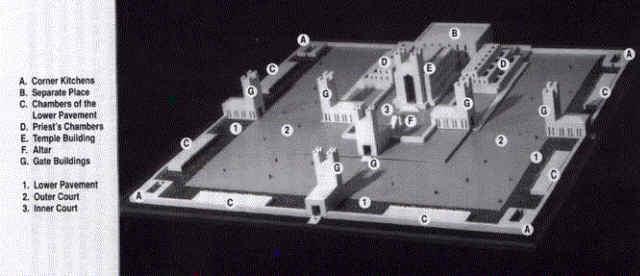
Ezekiel’s vision of a temple is enigmatic. Few passages in the entire Bible are more difficult to understand than chapters 40 to 48 of the Book of Ezekiel where the prophet describes in detail a temple—a habitation for YHVH himself—that he saw in a vision. Ezekiel’s temple is similar to the Tabernacle of Moses and Solomon’s Temple, but different and grander.
Is this temple to be actually built during the Messianic Era or Millennium (which is the most common interpretation of this prophetic passage)? Or is this temple not a literal temple that will be built, but only figurative and spiritual in nature containing some hidden spiritual message? Bible commentators are uncertain. The Christian commentator Matthew Henry brushes off the vision with a scant commentary giving the following reasoning why: “Here is a vision … which is justly looked upon to be one of the most difficult portions in all the book of God. When we despair to be satisfied as to any difficulty we meet with, let us bless God that our salvation does not depend upon it, but that things necessary are plain enough; and let us wait till God shall reveal even this unto us.” Not content to leave this issue on Matthew Henry’s spiritual back burner, this author has assembled a series of insightful quotes from scholars who have studied Ezekiel’s Temple in depth and have some thought-provoking ideas as to its spiritual significance that may well spur the reader to examine this subject more thoroughly for himself.
Next, we present some excerpts from some Jewish and Christian commentaries on the subject of Ezekiel’s temple.
The Soncino Pentateuch sees this vision describing a temple that will be built in the New Jerusalem after the return of the exiled Israelites, which occurs when Messiah comes to establish his kingdom on earth. “This new temple was … to symbolize and embody in concrete form the teachings of Holiness and Purity preached by the Prophet in the preceding 39 chapters of his book.… The real hope of the future for Ezekiel lies in perfect and willing obedience to the Law” (p. 350).
The ArtScroll Chumash notes that at the beginning of the Book of Ezekiel the prophet is shown the glory of YHVH departing the Temple in Jerusalem because of all the abominations done therein (Ezek 9 and 10). That Temple became but an empty shell destined for soon destruction at the hands of the Babylonians. “But [Elohim] removes his Presence from places, not from his people. Throughout Ezekiel’s sad task of warning the nation of the consequences of its waywardness, [Elohim] told him that Israel would remain his people, that he would share their exile, and that he would bring them home again. In the concluding chapters of the book, Ezekiel saw the vision, the architecture, the dimensions, the laws of the Third Temple. Finally, he saw the vision of the Shechinah’s [YHVH’s glorious Presence] return—the same Shechinah whose departure he had tearfully witnessed twenty years earlier” (pp. 1158–1159).
The essence of the nine chapters devoted to describing this temple is found in 48:35 where the name of the city is given: YHVH Is There/YHVH Shama (vnÑ vuvh), according to the ArtScroll Tanch Series Ezekiel Commentary. The focus of the New Jerusalem is that it is the resting place of the Divine Presence. “[Elohim] wills that there be a New Jerusalem only because he wills that there be a place of welcome for the Divine Presence.… This Temple is to become the throne and footstool for the Divine Presence (43:7) and, in contrast to the two previous Temples which became defiled—and subsequently destroyed—through Israel’s sins, this one is to stand inviolate. [Elohim] is to dwell in it, never to depart (43:7)” (p. 605).
Adam Clarke in his commentary sees a direct correlation between the layout of Ezekiel’s temple and the message of the cross. “The tabernacle and temple were types of the incarnation of [Yeshua the Messiah]: ‘Destroy this temple, and after three days I will raise it up;—but this he spoke of the temple of his body’ (John 2:19,21). And in that Temple ‘dwelt all the fullness of the Godhead bodily.’ Into this immaculate humanity did the glory of the Supreme [Elohim] enter; and thus, ‘[Elohim] was in [Messiah] reconciling the world to himself.’ And this [Yeshua] is Immanuel, [El] with us” (Clarke’s Commentary, vol. 4, p. 540).
So what is the bottom line here? Will Ezekiel’s Temple literally be built or is it merelyEzekiel’s Temple—A Literal Millennial Temple
There are solid biblical reasons to believe that Ezekiel’s temple vision foretells a literal temple that will be built in the future. In Messiah’s Coming Temple—Ezekiel’s Prophetic Vision of the Future Temple, by John W. Schmitt and J. Carl Laney, the authors make a compelling case for this being a description of a literal millennial temple. “Taken literally, Ezekiel 40–48 describes a temple that will exist during the kingdom (millennial age). Also Ezekiel is not alone in his prediction regarding a future temple; other prophets confirm the view that there will be a literal temple in the future kingdom (Isa 2:3; 60:13; Jer 33:18; Joel 3:18; Mic 4:2; Hag 2:7–9; Zech 6:12–15; 14:16, 20–21)” (ibid. p. 81). Moreover, if we are to believe John’s account of the New Jerusalem’s river of life lined with trees of life (Rev 22:1–2), then we must believe that Ezekiel’s similar account is literal as well (Ezek 47:1, 7, 12).
Those who believe that Ezekiel’s Temple is an allegorical representation of this present church age “introducers unwarranted allegorization and tends to read ideas into the passage rather than drawing out the t ruth that is there. Furthermore, thee is very little that corresponds to the church in Ezekiel’s vision” (ibid., p. 81).
My Commentary: Get your head straight, wrap your mind around the fact that ISRAEL in the Millennial Kingdom is God's people which means The CHURCH, The Jewish Remnant, The Tribulation Saints, and The Old Testament Saints. See my studies above.
Here is commentary from
Ezekiel prophesied about a future temple that is still to come1. Critics argue that if there is a literal, future temple, then it will require a return to the sacrificial system that Christ made obsolete2. Since the destruction of the Second Temple in AD 70, the Jewish People can no longer offer these sacrifices3. Critics believe that this is a contradiction to the finished work of Christ2.
These Links are proactively wicked and unbiblical. They are ADAMANTLY Professing themselves as JUDAIZERS. Note they are unashamed to proclaim JEWS (ETHNIC) are only God’s chosen and therefore the Gentiles (considered to be any person not JEWISH) are the DOGS outside the temple:
Ten Lines of Evidence for Interpreting Ezekiel 40-48 as Depicting a Literal Temple
December 13, 2021
Ten Lines of Evidence for Interpreting Ezekiel 40-48 as Depicting a Literal Temple
By Paul Henebury
Some amillennialists think that the original hearers of Ezekiel couldn’t comprehend a future glorious kingdom where Israel is regenerate, and Messiah reigns in justice and righteousness from Jerusalem. That they couldn’t see a time where priests serve God in a new temple.
I think they could in fact do this from attending to the following passages: Num. 25:10-13; Deut. 30:6f., or Psa. 2, 89, 105, 106, Isa. 2, 11, 26-27, 35, 43, 44, 45, 51, 62; Jer. 23, 30, 31, 33, or Hos. 2:16f. or Mic. 4, or Zeph. 3, or indeed from Ezek. 34, 36-37.
It seems that Ezekiel’s near contemporary Zechariah (Zech. 6:12-13, 8:1-3; 14:16f.), and Malachi (Mal. 3:2-3) believed these things too. Zechariah, for example, predicts a future temple built after Jerusalem has been changed topographically where the King is worshiped at the temple (Zech. 14).
No premillennialist, or Dispensationalist (or Biblical Covenantalist) would say that Ezekiel’s audience could know the time when the temple would be built. They could only know that it would be built. They could know this because Ezekiel’s temple could only be constructed…
a) once Israel were no longer under the Mosaic covenant – because the service etc. of Ezekiel’s temple does not agree with Moses.
b) after topographical changes occurred which would make the huge project possible.
c) once the glory of the Lord was ready to return to bless Israel and dwell with them forever. That didn’t happen in Nehemiah’s day, and it hasn’t happened yet, so logically it must either be the future (or else these chapters form one of the greatest circumlocutions in all of literature!)
Again, Ezekiel didn’t know that the Messianic Kingdom would last a thousand years. He didn’t have John’s Revelation (some who have the Book of Revelation still don’t know that Christ will reign a thousand years!). We don’t have to demonstrate anything that wasn’t revealed after Ezekiel’s time to realize that his original audience knew he was referring to a future temple.
But here are ten evidences that Ezekiel meant us to understand him as referring to a literal temple building complex that will be erected in future Israel.
1. Ezekiel calls it a temple over and over. E.g. In Ezekiel 40:5, 45 – where the priestly function is mentioned; in Eze. 41:6-10 – where its chambers are described in pedantic detail; in Eze. 42:8 – where the length of the chambers depends on their position relative to the sanctuary; in Eze. 43:11 – where God declares: “make known to them the design of the house, its structure, its exits, its entrances, all its designs, all its statutes, and all its laws. And write it in their sight, so that they may observe its whole design and all its statutes, and do them.” How can any reader take these details seriously and find their fulfillment in the NT church?
Moving forward in the passage, in Ezekiel 43:21 a bull is to be offered as a sin-offering outside the house; in Eze. 45:20 – an atonement is made for the simple on the seventh day of the month; in Eze. 46:24 – sacrifices are boiled at designated places; and in Eze. 48:21 – the huge allotment for the sanctuary is measured (it is very different to New Jerusalem in Rev. 21!).
2. There are laws to perform in the temple (Ezek. 43:11-12). Quite how one can perform these commands in the church is a mystery beyond the mystery of the church itself.
3. Ezekiel stipulates two divisions of priests, only one of whom (Zadokites) can approach the Lord (Eze. 44:15). These Zadokites are given land separate from other Levites (Eze. 48:11).
4. Ezekiel refers to New Moons and sacrifices (Eze. 46:1, 6). New Jerusalem has no need of moonlight (Rev. 21:23).
5. The tribes of Israel are given specific allotments of land all around the temple (Ezek. 48)
6. The two temples at the beginning and the end of the Book of Ezekiel form a structural arc. The first temple is literal. Nothing is said about the more detailed temple at the end of Ezekiel being a mere symbol. In fact, in Ezekiel 8:3ff. “the visions of God” recorded what really did occur (cf. Eze. 40:2), not what would symbolically happen.
7. In Ezekiel 10 the Shekinah leaves the actual temple in Jerusalem by the East Gate. In chapter 43 it returns via the East Gate and remains.
8. A sanctuary is mentioned in the new covenant chapters (Ezekiel 36 & 37). For example, after Israel has been cleansed, God declares: “I will make a covenant of peace with them; it will be an everlasting covenant with them. And I will place them and multiply them, and will set My sanctuary in their midst forever.” (Ezek. 37:26. cf. 43:7).
This indicates something about the timing of the fulfillment of the temple prophecy. This agrees with the timing indicated in the last verse of Ezekiel: “the name of the city from that day shall be, ‘The LORD is there” (Ezek. 48:35)
9. At least three times Ezekiel is commanded to pay close attention to specifics: Eze. 40:4; 43:10-11; 44:5. The symbolic interpretation ignores these details when seeking to explain the meaning of the vision. If an interpretation passes over what God has told us to pay close attention to, that interpretation must be suspect.
10. A future temple is necessary in light of God’s everlasting covenant with the Zadokites’ ancestor Phinehas (Num. 25:10-13; Psa. 106:30-31. Cf. Jer. 33:14f., Mal. 3:1-4). Zechariah 6:12-13; 14:8-9, 16f., describes temple conditions in Israel which have never yet existed, but which match Ezekiel 36-48.
Please look up the references above and see if I have distorted what the verses say. I have simply allowed the Bible to speak. If someone doesn’t believe these evidences and instead wants to interpret a portion of the Bible that is longer than First Corinthians as a “word-picture” or “type”, then let them explain their interpretation from the text. I think that is a reasonable position.
Ten Lines of Evidence for Interpreting Ezekiel 40-48 as Depicting a Literal Temple - Rapture Forums
Timeline of Ezekiel | Precept Austin
Ezekiel 40-48 2nd Temple Vision
Comments
Post a Comment